
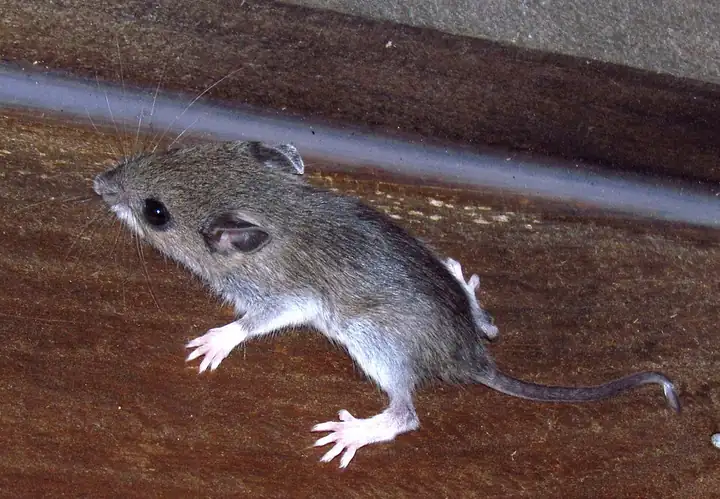
Mice (house mice and deer mice)
House mouse, and deer and white-footed mice (Peromyscus species, including the deer mouse, Peromyscus maniculatus)
| Type | Animal |
|---|---|
| When | Year-round; garden damage is worst at seeding time and in fall and winter. |
| Pressure by region | Moderate: Northeast, Southeast, South Central, Midwest, Great Plains, Mountain West, Southwest, Pacific Northwest, California, Hawaii |
About
Small seed-eating rodents that move into gardens, sheds and homes, especially in fall and winter. They dig up planted seeds, eat bulbs and low-hanging produce and gnaw the bark of young trees, and deer mice carry hantavirus, so handle their droppings with care (UConn, UC IPM).
Spotting it
Damage
Mice dig up and eat planted seeds, including melon seeds, bite into ripening tomatoes, cucumbers, beans and peas that hang near the ground, and hollow out potatoes, carrots, beets and parsnips (UConn, UC IPM). Under snow they dig for seeds and bulbs and gnaw the bark and roots of young trees and shrubs; in a USDA study, house mice killed over half the young cottonwood seedlings penned with them (UConn, USDA).
How to find it early
Look for small dug holes along seed rows, gnawed fruit near the ground and tiny droppings. Deer mice have white bellies and feet, big eyes and ears and a two-tone tail; house mice are gray-brown with a nearly hairless tail and a mousy smell (UC IPM, UConn). Voles have their own page.
When
Year-round; garden damage is worst at seeding time and in fall and winter.
Life cycle
Deer mice have litters of three to six young, can breed at six weeks old, and breed mostly outside winter, or year-round where it's warm; few live past two years. They don't hibernate, and they stash seeds in fall (UC IPM).
What to do, gentlest first
Start at the top. Sprays are a last step; always read and follow the product label.
Remove cover Prevent
Clear overgrown weeds, brush, hedges and wood piles near beds and buildings. This cuts numbers but won't get rid of mice (UC IPM).
Seal sheds and the house Prevent
Close gaps larger than 1/4 inch with metal or concrete, since mice chew through plastic, foam and wood; steel wool works as a temporary plug (UC IPM).
Clean up droppings safely Prevent
Air out a shed or garage for at least 30 minutes before cleaning. Wearing rubber or nitrile gloves, soak droppings and nests with disinfectant or a bleach solution (1 1/2 cups bleach per gallon of water), wait about 10 minutes, then wipe them up (UC IPM).
Never sweep or vacuum dry droppings; the dust can spread hantavirus (UC IPM).
Cage seedbeds and young trees Barrier
Cover seeded flats and beds with 1/4-inch wire mesh with the edges buried a few inches, or with upside-down plastic berry baskets. Stake or trellis peas and tomatoes so fruit stays off the ground, and guard young trees with wire set 1/2 to 1 inch away from the trunk (UConn).
Snap traps Trap
Bait snap traps with peanut butter, oatmeal or sunflower seeds, set several along walls and at right angles to runways, and check them daily (UConn, UC IPM).
Wear gloves and keep set traps where children and pets can't reach them. Don't use glue boards or live traps for deer mice, which raise the risk of hantavirus exposure (UC IPM). This guide does not recommend poison baits, which put pets, children and other wildlife at risk; UC IPM notes none are registered for deer mice around homes. Rules on trapping wild animals differ from state to state, so check with your state wildlife agency if you're unsure.
Skip repellents and gadgets Repellent
UC IPM says ultrasonic devices and chemical repellents don't work against deer mice, and UConn says no repellent has fully solved a mouse problem.
Predators help a little Natural enemies
Cats and other predators catch some mice but rarely control them on their own (UC IPM, UConn).
Plants it goes after
Beet, Blueberry, Cantaloupe (muskmelon), Carrot, Cucumber, Green beans (snap beans), Nanking cherry, Parsnip, Peanut, Peas, Potato, Ranunculus, Rose (garden and landscape roses), Saffron crocus, Salsify (oyster plant), Tomato, Watermelon
Pressure by region
The deer mouse is one of the most widespread mammals in North America (UC IPM). No regional severity source was found, so all ratings are estimates.
| Northeast | Moderate |
|---|---|
| Southeast | Moderate |
| South Central | Moderate |
| Midwest | Moderate |
| Great Plains | Moderate |
| Mountain West | Moderate |
| Southwest | Moderate |
| Pacific Northwest | Moderate |
| California | Moderate |
| Alaska | Low |
| Hawaii | Moderate |
Ratings come from extension sources where available; some are estimates, as noted above.
Sources
Photo: Photo: D. Gordon E. Robertson / Wikimedia Commons, CC BY-SA 3.0 (CC BY-SA 3.0). Photo resized for the web.

Planting dates and advice are general guidance; check with your local Cooperative Extension office for your area.