
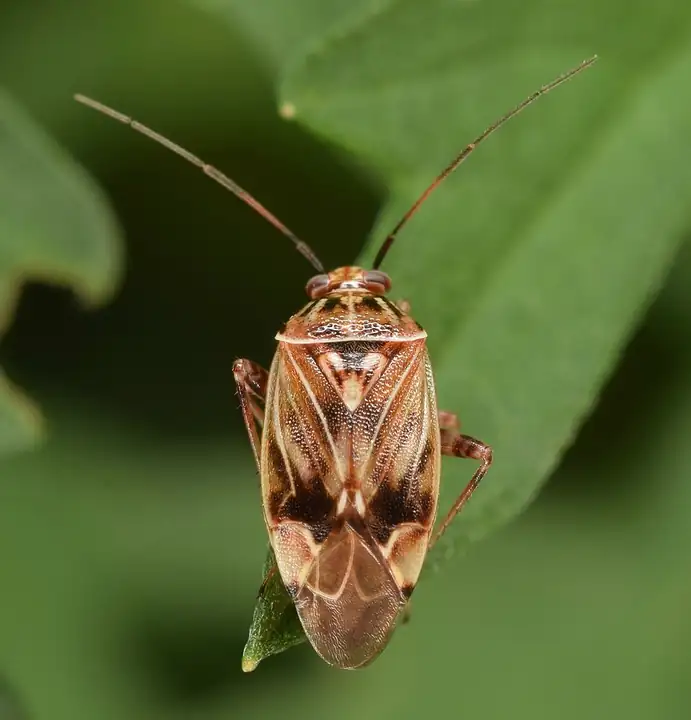
Tarnished plant bug
Lygus lineolaris
| Type | Insect |
|---|---|
| When | Spring through summer. |
| Pressure by region | Moderate: Northeast, Southeast, South Central, Midwest, Great Plains, Mountain West, Southwest, Pacific Northwest, California |
About
A small, flattened, greenish-brown bug about a quarter inch long found throughout North America. It feeds on more than half of the continent's commercially grown crops.
Spotting it
Damage
Feeding on buds, flowers and young fruit causes cat-faced, seedy strawberries, scarred fruit, dropped buds and dead shoot tips.
How to find it early
Scout from mid-April to early May for damaged buds, and use white sticky boards to catch early adults.
When
Spring through summer.
Life cycle
Adults overwinter in plant debris and under bark and become active in spring; eggs are laid inside plant tissue and hatch in about 10 days. There are two generations a year in New Hampshire and two to five across its range.
What to do, gentlest first
Start at the top. Sprays are a last step; always read and follow the product label.
Weeds and debris Prevent
Clean up weeds and fall debris where the bugs lay eggs and overwinter, and keep strawberries and vegetables away from clover and alfalfa.
White sticky boards By hand
Set white sticky boards in spring to see when bugs arrive.
Floating row cover Barrier
Cover low-growing crops early in the season.
Remove it at flowering so pollinators can reach the blooms.
Parasitic wasp Natural enemies
A parasite of this bug established in New Hampshire in the 1980s gives partial control; avoid sprays that kill it.
It does not completely control the pest.
Labeled insecticides Conventional spray
Check your state's fruit or vegetable guide or county Extension for current products.
Strawberries and fruit trees are in bloom when these bugs feed, so protect bees. Follow the label and pre-harvest interval.
Garden friends that go after it
Crab spiders (flower spiders), Damsel bugs
Protect these helpers: skip broad sprays when they're around.
Plants it goes after
Apple (backyard tree), Buckwheat (flowering cover crop), Carrot, Celeriac, Green beans (snap beans), Highbush cranberry (American cranberrybush), Lentil, Lettuce, Lima beans, Lovage, Marigold, Peach, Potato, Statice (annual statice), Strawberry, Strawflower, Sunflower, Tomato, Zinnia
Pressure by region
Found from northern Canada to southern Mexico (University of Maine), so no regional hot spots are rated. No Alaska or Hawaii source was found, so both low ratings are estimates.
| Northeast | Moderate |
|---|---|
| Southeast | Moderate |
| South Central | Moderate |
| Midwest | Moderate |
| Great Plains | Moderate |
| Mountain West | Moderate |
| Southwest | Moderate |
| Pacific Northwest | Moderate |
| California | Moderate |
| Alaska | Low |
| Hawaii | Low |
Ratings come from extension sources where available; some are estimates, as noted above.
Sources
Photo: Photo: Christina Butler, CC BY 2.0, via Wikimedia Commons (CC BY 2.0). Photo resized for the web.

Planting dates and advice are general guidance; check with your local Cooperative Extension office for your area.