
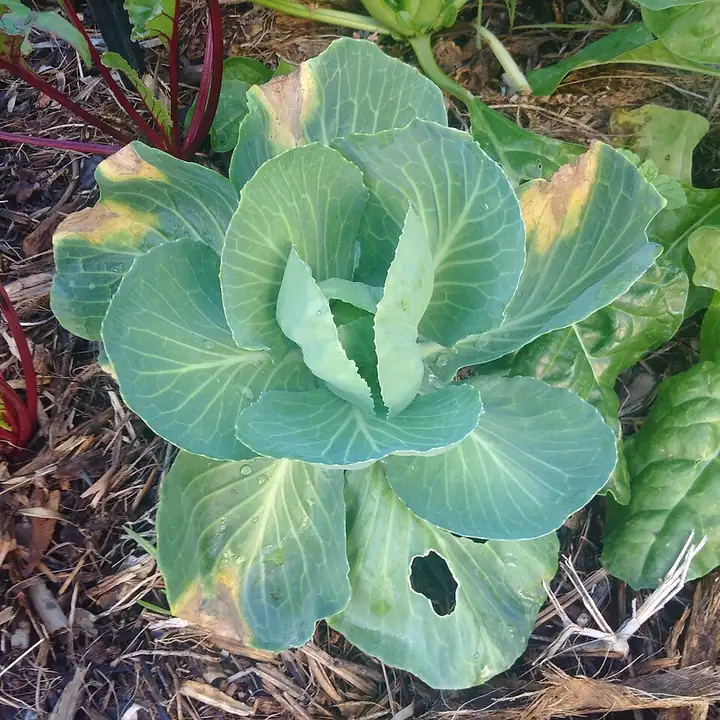
Black rot of cabbage-family crops
Bacterium (Xanthomonas campestris pv. campestris)
| Type | Bacteria |
|---|---|
| Cause | Bacterium (Xanthomonas campestris pv. campestris) |
| When | Warm, wet weather in summer. |
About
Black rot is a serious bacterial disease of cabbage, broccoli, cauliflower, kale and their relatives. It usually arrives on seed or transplants, and one infected seed in 10,000 can start a severe outbreak.
Also called black rot
How to recognize it
Symptoms
Yellow, V-shaped patches start at the leaf edge and point toward the midrib, and the veins inside them turn black. Patches turn brown and dry, leaves drop, and the infection can move into the stem, blackening its inner tissue and wilting the plant.
Often confused with
Fusarium yellows also yellows cabbage leaves, often on one side of the plant, but does not blacken the leaf veins in V-shaped patches.
Worse when
Warm (80 to 86°F), humid, wet weather and anything that wounds leaves.
How it spreads
Carried on seed and transplants and spread by splashing water, wind, insects, hands and tools; bacteria survive up to two years in plant debris and in mustard-family weeds.
When
Warm, wet weather in summer.
What to do, gentlest first
Prevention works best; most sprays only protect healthy leaves and can't cure infected ones. Always read and follow the product label.
Clean seed and transplants Prevent
Use certified disease-free seed, or hot-water-treated seed (UMass: 15 to 30 minutes at 122°F/50°C, then dry and test germination). Buy clean transplants.
Hot-water treatment must be exact or it can kill seed.
Resistant varieties Prevent
WSU lists resistant cabbages such as 'Defender' and 'Guardian' and tolerant ones such as 'King Cole' and 'Superdane'.
Rotate and weed Prevent
Keep cabbage-family crops out of the same spot for three years and control mustard-family weeds.
Drip and dry leaves Prevent
Use drip irrigation, avoid working in wet plants, and clean tools with 70% alcohol or 10% bleach.
Remove infected plants and debris By hand
Pull infected plants and destroy them rather than composting, and clear crop debris after harvest.
Copper, before infection only Organic spray
UMass says copper may help prevent infection if applied before plants are infected, every 7 to 10 days with good coverage of leaf undersides.
Copper does not cure infected plants, and WSU recommends no chemical control for home gardens. Copper only protects leaves it coats before infection; it will not heal spots already there. It can burn young leaves, especially in weather above 85°F, and some plants are sensitive (Purdue lists celery, strawberry, apple, pear and plum among them). PNW 591 rates copper hydroxide toxic to bees, so spray when bees are not foraging. Follow the label, including the days to wait before harvest.
Plants it affects
Arugula, Bok choy, Broccoli, Brussels sprouts, Cabbage, Cauliflower, Collards, Kale, Kohlrabi, Mustard greens, Napa cabbage, Radish, Rutabaga, Tatsoi, Turnip
Sources
Photo: Photo: Scot Nelson, CC0, via Wikimedia Commons (CC0). Photo resized for the web.

Planting dates and advice are general guidance; check with your local Cooperative Extension office for your area.