
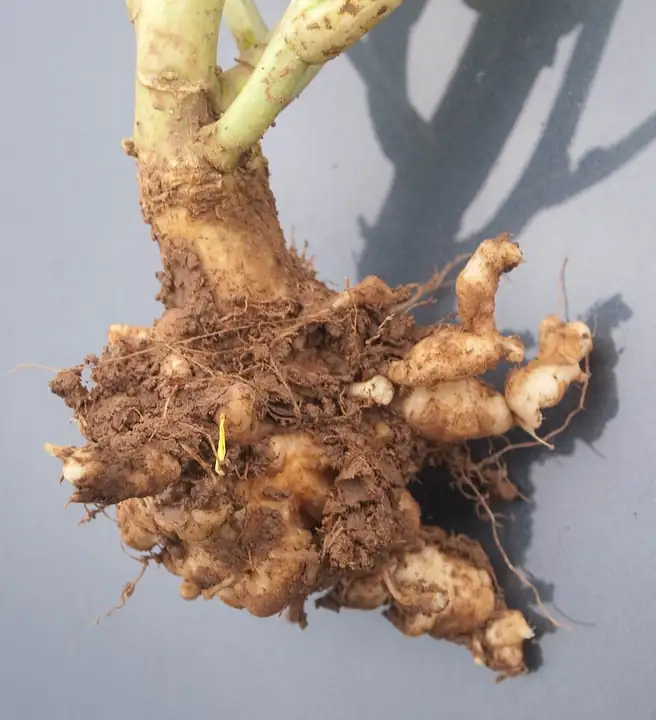
Clubroot
Soilborne single-celled parasite (Plasmodiophora brassicae), a protist rather than a true fungus
| Type | Fungus |
|---|---|
| Cause | Soilborne single-celled parasite (Plasmodiophora brassicae), a protist rather than a true fungus |
| When | Through the growing season; symptoms show most on warm afternoons. |
About
Clubroot swells and deforms the roots of cabbage-family crops, starving the plant of water. Its spores can survive in soil for up to 20 years, so keeping it out of your garden is far easier than getting rid of it.
Also called clubroot, club root
How to recognize it
Symptoms
Plants are stunted and wilt on warm afternoons even with only slight dryness, and leaves may yellow. Pulled up, roots are swollen into thick clubs or spindles, which later rot and turn black.
Worse when
Acidic soil (pH below about 6.5) and wet, poorly drained soil.
How it spreads
Spores move on infected transplants, soil on tools and boots, unheated compost and wind-blown soil, and survive up to 20 years; many weeds can carry it without symptoms.
When
Through the growing season; symptoms show most on warm afternoons.
What to do, gentlest first
Prevention works best; most sprays only protect healthy leaves and can't cure infected ones. Always read and follow the product label.
Start with clean transplants Prevent
Grow your own or buy transplants raised in clean soil, and use only compost heated to at least 148°F.
Raise soil pH with lime Prevent
Keep soil pH at 6.8 or higher (WSU) and maintain calcium and magnesium; get a soil test first.
Long rotation and drainage Prevent
Leave cabbage-family crops out of infested beds for 5 to 7 years or more, remove mustard-family weeds, and do not plant in soggy soil. Resistant varieties exist for some crops.
Remove infected roots and clean tools By hand
Dig out infected plants with their roots and do not compost them in regular piles. Clean tools with a 1:9 bleach and water solution.
No home fungicides Conventional spray
WSU notes no fungicides are labeled for home use against clubroot.
Plants it affects
Arugula, Bok choy, Broccoli, Broccoli raab (rapini), Brussels sprouts, Cabbage, Cauliflower, Collards, Kale, Kohlrabi, Mustard greens, Napa cabbage, Radish, Rutabaga, Turnip
Sources
Photo: Photo: Leafhopper65, Public domain, via Wikimedia Commons. Photo resized for the web.

Planting dates and advice are general guidance; check with your local Cooperative Extension office for your area.