
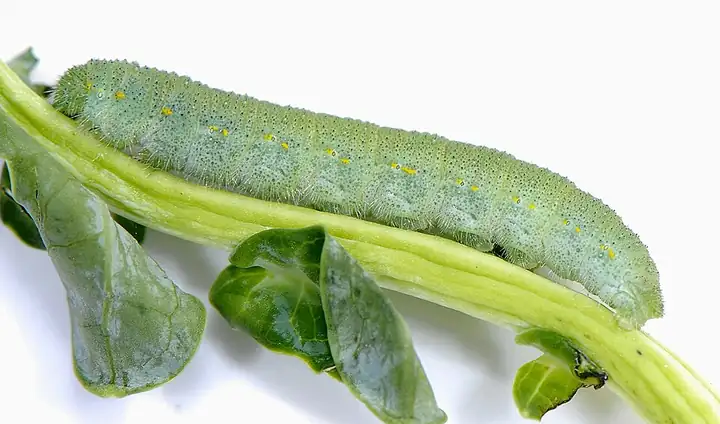
Imported cabbageworm
Pieris rapae (the adult is the cabbage white butterfly)
| Type | Insect |
|---|---|
| When | Mid-May through fall in the North; longer in the South. |
| Pressure by region | Moderate: Northeast, Southeast, South Central, Midwest, Great Plains, Mountain West, Southwest, Pacific Northwest, California, Hawaii |
About
The velvety green caterpillar, up to about an inch long with a faint yellow stripe, of the familiar white butterfly with black wing spots. It arrived in North America around 1860 and is now widespread across the continent.
Spotting it
Damage
Small caterpillars chew small holes; bigger ones make large ragged holes but leave the veins. They crawl into heads and leave green droppings that foul the harvest.
How to find it early
Watch for white butterflies circling your cabbage-family crops, then check leaf undersides for single yellow, oblong eggs and green caterpillars lying along the midrib.
When
Mid-May through fall in the North; longer in the South.
Life cycle
It overwinters as a chrysalis on plants or debris. There are two to three generations a year in Canada, three in New England, three to five in California and six to eight in the South, where it can stay active year-round in Florida.
What to do, gentlest first
Start at the top. Sprays are a last step; always read and follow the product label.
Plant early and clean up Prevent
Early planting lets you harvest before populations peak. Remove crop debris after harvest and control weeds where pupae overwinter.
Hand-pick By hand
Pick caterpillars and eggs into soapy water every few days.
Floating row cover Barrier
Cover plants at seeding or transplanting so butterflies cannot lay eggs. Seal the edges.
Let natural enemies work Natural enemies
Parasitic wasps, paper wasps, lady beetles and birds all attack cabbageworms, and a virus disease can kill over 90 percent in crowded populations.
Bt (Bacillus thuringiensis var. kurstaki) Natural enemies
Spray small caterpillars with Bt, covering the leaves well. It is very effective and spares bees.
Spinosad Organic spray
Spinosad also suppresses cabbageworm.
Toxic to bees while wet; spray in the evening when bees are not foraging, keep it off open flowers, and follow the label and pre-harvest interval.
Pyrethroids Conventional spray
Permethrin, beta-cyfluthrin or lambda-cyhalothrin are options for heavy infestations.
Highly toxic to bees (PNW 591), and they kill natural enemies. Check that your crop is on the label and wait the pre-harvest interval.
Garden friends that go after it
Braconid wasps (incl. hornworm cocoon wasps and aphid mummy wasps), Paper wasps, Spined soldier bug, Trichogramma wasps
Protect these helpers: skip broad sprays when they're around.
Plants it goes after
Bok choy, Broccoli, Brussels sprouts, Cabbage, Cauliflower, Collards, Kale, Kohlrabi, Mizuna, Napa cabbage, Nasturtium, Ornamental kale and cabbage, Rutabaga, Sweet alyssum, Tatsoi
Pressure by region
Found across North America wherever cabbage-family crops grow, with more generations in warmer zones. It is on Hawaii's home-garden pest list (CTAHR). No Alaska source was found, so Alaska's low rating is an estimate.
| Northeast | Moderate |
|---|---|
| Southeast | Moderate |
| South Central | Moderate |
| Midwest | Moderate |
| Great Plains | Moderate |
| Mountain West | Moderate |
| Southwest | Moderate |
| Pacific Northwest | Moderate |
| California | Moderate |
| Alaska | Low |
| Hawaii | Moderate |
Ratings come from extension sources where available; some are estimates, as noted above.
Sources
Photo: Photo: Sam Fraser-Smith, CC BY 2.0, via Wikimedia Commons (CC BY 2.0). Photo resized for the web.

Planting dates and advice are general guidance; check with your local Cooperative Extension office for your area.