
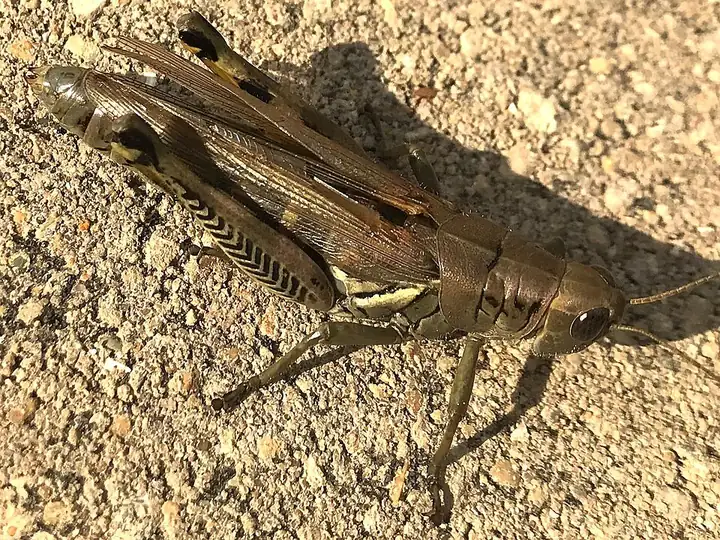
Grasshoppers
Many species (family Acrididae), such as the differential grasshopper (Melanoplus differentialis)
| Type | Insect |
|---|---|
| When | Late spring through fall. |
| Pressure by region | High pressure: Great Plains, Mountain West |
About
Jumping insects with big hind legs that often invade gardens from surrounding dry fields and grassland. Only about a dozen of the roughly 400 species in the western U.S. are serious pests.
Spotting it
Damage
Ragged holes are chewed in leaves, and heavy numbers can strip plants. Colorado State says they tend to avoid squash, peas and tomato leaves, though not tomato fruit.
How to find it early
In late spring, walk weedy edges, fencerows and ditches next to the garden, where new nymphs bunch up near where they hatched.
When
Late spring through fall.
Life cycle
Females lay pods of eggs in undisturbed soil in late summer and fall; eggs hatch the next spring and nymphs molt five or six times over 35 to 50 days. Most species have one generation a year.
What to do, gentlest first
Start at the top. Sprays are a last step; always read and follow the product label.
Watch next year's crop now Prevent
Big grasshopper numbers in late summer predict trouble the next year. Guinea hens help control them in rural yards.
Scout the edges early By hand
Find the young nymphs in weedy borders in late spring, while they are under half an inch, before they spread into the beds.
Screening or row cover Barrier
Cover prized crops with floating row cover, which Oklahoma State says lets light and air through yet is strong enough to keep grasshoppers from feeding.
Nosema locustae bait Natural enemies
This bait infects young grasshoppers, so spread it early in the season.
Only young nymphs are affected, typical kill is 30 to 40 percent at best, it works poorly in hot, dry weather, and the bait is perishable.
Carbaryl or pyrethroids on young nymphs Conventional spray
Spray or bait field edges in May and June while grasshoppers are small (second and third stage, under half an inch).
Sprays on plants do little once adults are flying in, and heavy infestations may need repeats every 3 to 4 days. Both are highly toxic to bees (PNW 591), so keep them off flowering plants. Check that the label lists your vegetable and follow its pre-harvest interval. Carbaryl has been a restricted-use material in California since August 1, 2020 (UC IPM), so home gardeners there cannot buy it.
Garden friends that go after it
Assassin bugs (incl. the wheel bug), Garden orb weavers (incl. yellow garden spider), Harvestmen (daddy longlegs), Jumping spiders, Mud daubers and other solitary hunting wasps, Praying mantids, Robber flies, Soldier beetles (leatherwings)
Protect these helpers: skip broad sprays when they're around.
Plants it goes after
Basil, Blue grama, Buffalograss, Carrot, Gladiolus, Green beans (snap beans), Larkspur (annual larkspur), Lavender (English), Lentil, Lettuce, Olive, Onion, Penstemon (beardtongue), Statice (annual statice), Strawflower, Sweet corn, Yacon
Pressure by region
USDA surveys pest grasshoppers across 17 western states from the Dakotas and Texas to the Pacific, where outbreaks hit rangeland especially during drought. Pacific Northwest and California are on that list but rated low for gardens for lack of a garden-level source. The Northeast, Southeast, Midwest, Alaska and Hawaii ratings are also estimates; Hawaii's home-garden guide lists several grasshopper species (CTAHR).
| Northeast | Low |
|---|---|
| Southeast | Low |
| South Central | Moderate |
| Midwest | Low |
| Great Plains | High pressure |
| Mountain West | High pressure |
| Southwest | Moderate |
| Pacific Northwest | Low |
| California | Low |
| Alaska | Low |
| Hawaii | Low |
Ratings come from extension sources where available; some are estimates, as noted above.
Sources
- extension.okstate.edu
- extension.colostate.edu
- aphis.usda.gov
- www3.ctahr.hawaii.edu
- s3.wp.wsu.edu
- ipm.ucanr.edu
Photo: Photo: Peterwchen, CC BY-SA 4.0, via Wikimedia Commons (CC BY-SA 4.0). Photo resized for the web.

Planting dates and advice are general guidance; check with your local Cooperative Extension office for your area.