
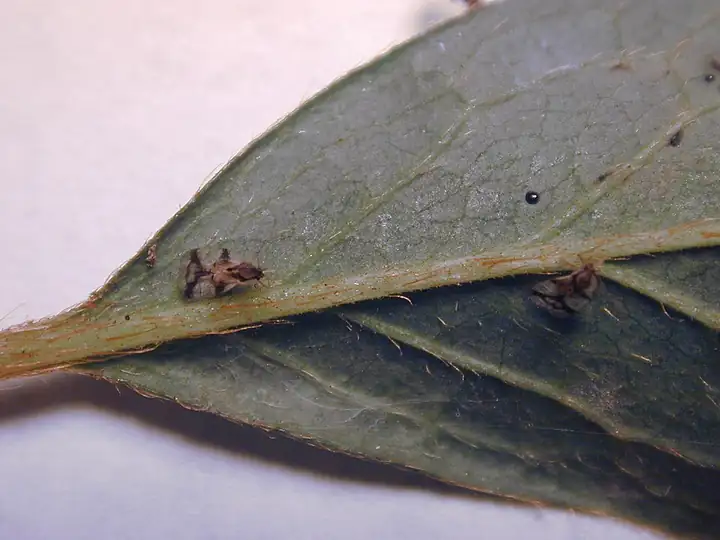
Lace bugs (azalea and chrysanthemum lace bugs)
Azalea lace bug (Stephanitis pyrioides) and chrysanthemum lace bug (Corythucha marmorata); many other lace bug species feed on trees and shrubs
| Type | Insect |
|---|---|
| When | Spring through fall; on azaleas the spring generations do the most harm. |
| Pressure by region | High pressure: Southeast |
About
Lace bugs are flat insects about 1/8 inch long whose clear, net-veined wings look like lace. The azalea lace bug, native to Japan, is a major pest of azaleas, and the chrysanthemum lace bug feeds on mums, asters, goldenrod, sunflowers and their relatives (NC State, Oregon State).
Spotting it
Damage
Adults and nymphs suck sap from leaf undersides, leaving pale stippling on top that can bleach leaves almost white or bronze. Dark, varnishlike specks of excrement under the leaves are a giveaway (NC State, UC IPM). The harm is mostly to looks; Oregon State says azaleas tolerate up to 14% leaf damage without losing growth.
How to find it early
Starting in late winter or early spring, check new leaves about once a week for the first pale specks (UC IPM). NC State says the spring generations do the most damage to azaleas. Turn leaves over to find the dark, spiny nymphs and black specks.
When
Spring through fall; on azaleas the spring generations do the most harm.
Life cycle
Azalea lace bugs spend winter as eggs tucked into the leaf along the midrib and have two to four generations a year (Oregon State, UMass). Chrysanthemum lace bugs spend winter in dry leaves, grass clumps and other sheltered debris (NC State).
What to do, gentlest first
Start at the top. Sprays are a last step; always read and follow the product label.
Site and choose azaleas with care Prevent
In the East, azaleas in sun, especially afternoon sun, are about twice as likely to be infested, so UMass suggests partial shade; in the Pacific Northwest, Oregon State says shade-grown azaleas suffer more. 'Micrantha' and native azaleas such as Rhododendron atlanticum, R. arborescens, R. canescens and R. periclymenoides resist lace bugs (Oregon State, UMass).
Hose off nymphs By hand
Spray leaf undersides with a strong stream of water to knock off nymphs (UC IPM).
Protect natural enemies Natural enemies
Lacewings, lady beetles, minute pirate bugs, predatory plant bugs, spiders and tiny wasps that attack lace bug eggs all help (Oregon State, NC State).
Natural enemies may not prevent damage on their own (NC State).
Insecticidal soap or horticultural oil Organic spray
Spray leaf undersides thoroughly when nymphs have just hatched; Oregon State reports up to 90% control with good coverage. Eggs inside the leaf are protected, so check again and repeat for the next hatch (NC State).
Soap and oil work only on contact. Oil can harm bees it hits for up to about 3 hours (PNW 591), so spray when bees are not on the plants. UC IPM advises against long-lasting sprays because they harm pollinators and natural enemies, and UMass advises spraying azaleas after bloom. Some guides list neonicotinoids; they harm pollinators, so skip them. Read and follow the label, including its pre-harvest interval if you eat any part of the plant.
Garden friends that go after it
Brown lacewings, Green lacewings
Protect these helpers: skip broad sprays when they're around.
Plants it goes after
Aster, Azalea, Chrysanthemum (garden mum), Goldenrod, Hackberry, Japanese pieris, Linden, Mountain laurel, Oaks (white, red and pin oak), Rhododendron, River birch, Sunflower, Sycamore
Pressure by region
The azalea lace bug was first found in New Jersey in 1915, spread through the mid-Atlantic and Southeast, and reached Washington in 2008 and Oregon in 2009 (Oregon State). If you find it in a new area of the West, report it to your state department of agriculture. UC IPM lists more than a dozen lace bug species in California. Other ratings are estimates.
| Northeast | Moderate |
|---|---|
| Southeast | High pressure |
| South Central | Moderate |
| Midwest | Moderate |
| Great Plains | Low |
| Mountain West | Low |
| Southwest | Low |
| Pacific Northwest | Moderate |
| California | Moderate |
| Alaska | Low |
| Hawaii | Low |
Ratings come from extension sources where available; some are estimates, as noted above.
Sources
- ipm.ucanr.edu
- content.ces.ncsu.edu
- content.ces.ncsu.edu
- ir.library.oregonstate.edu
- umass.edu
- s3.wp.wsu.edu
Photo: Photo: Forest & Kim Starr, CC BY 3.0 US, via Wikimedia Commons (CC BY 3.0 US). Photo resized for the web.

Planting dates and advice are general guidance; check with your local Cooperative Extension office for your area.