
Sawflies (garden sawflies)
Many species of plant-eating, non-stinging wasps (order Hymenoptera), such as the hibiscus sawfly, dogwood sawfly, columbine sawfly, dusky birch sawfly, scarlet oak sawfly and the pine sawflies; roseslugs, pear sawfly and imported currantworm have their own pages
| Type | Insect |
|---|---|
| When | Spring through summer; some species into fall. |
| Pressure by region | Moderate: Northeast, Southeast, South Central, Midwest, Pacific Northwest, California |
About
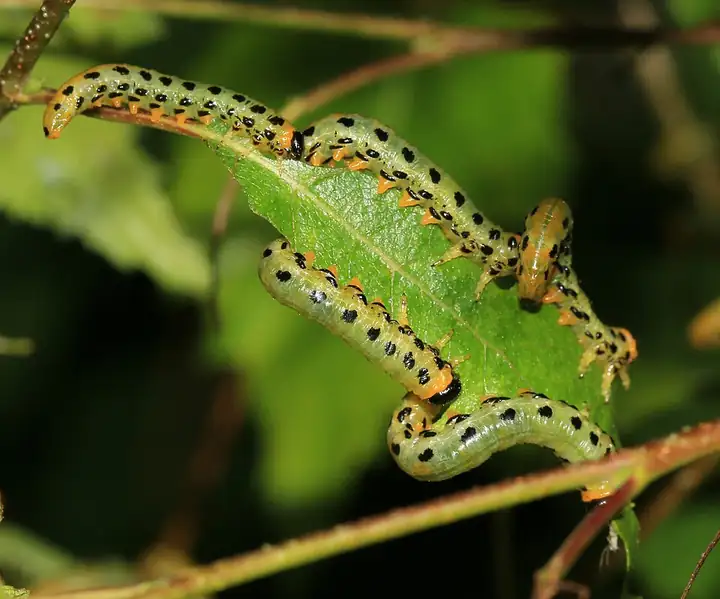
Sawflies are relatives of wasps and bees whose larvae look like caterpillars or small slugs and chew leaves. Each species sticks to a few plants, so roses, hibiscus, dogwoods, columbine, birches, oaks and pines each have their own kinds (UMD, UMN). The rose sawfly, pear sawfly and imported currantworm have their own pages.
Spotting it
Damage
Larvae chew leaf edges, eat the leaf between the veins so it looks lacy or windowpaned, or strip whole branches, often feeding in groups (UMN, UMD). On pines they first scrape needles, then eat them whole; pines don't regrow lost needles, and redheaded pine sawflies can kill small, stressed pines (UMN, UMD). Raspberry horntail larvae bore into cane tips instead (UC IPM).
How to find it early
From spring on, check favorite host plants for chewed leaves and clusters of larvae. Count the fleshy legs on the belly: sawfly larvae have six or more pairs, caterpillars five or fewer (UC IPM, UMN). Catch them while they are small.
When
Spring through summer; some species into fall.
Life cycle
Females cut slits in leaves, needles or shoots to lay eggs, and larvae feed for about four to six weeks (UMN). Most species have one or two generations a year and spend winter in the soil as prepupae or pupae, though the hibiscus sawfly has several generations a season (UMN, UMD).
What to do, gentlest first
Start at the top. Sprays are a last step; always read and follow the product label.
Healthy plants shrug off light feeding Prevent
Healthy trees and shrubs usually tolerate moderate leaf loss, and one season of feeding rarely harms a mature plant (UC IPM, UMN). Choose hardy plants, site them well and water them in dry spells (UMN).
Pick, prune or hose off By hand
Pick larvae into soapy water, clip off the infested twig, or knock them down with a strong spray of water; they can't climb back up (UMD, UMN, UC IPM).
Leave natural enemies Natural enemies
Birds, parasitic wasps, predatory beetles, small mammals and insect diseases often keep sawflies low (UC IPM).
Bt (Bacillus thuringiensis kurstaki) does not work on sawflies, because they aren't caterpillars (UC IPM, UMN, UMD).
Soap, oil, neem oil or spinosad on young larvae Organic spray
Larvae feeding out in the open die from almost any thorough spray, including insecticidal soap, horticultural oil, neem oil or spinosad. Spot-treat the group while larvae are less than half grown (UC IPM, UMN).
Spinosad stays toxic to bees for several hours after it dries, so don't use it on plants in flower (UC IPM). UC IPM advises against long-lasting broad-spectrum sprays such as carbaryl and pyrethroids, which harm bees and natural enemies. Some guides list neonicotinoids; they harm pollinators, so skip them. Follow the label and its pre-harvest interval on fruit plants.
Plants it goes after
Azalea, Cherry (sweet and tart), Columbine, Eastern hemlock, Eastern white pine, Flowering dogwood, Hardy hibiscus (rose mallow), Hollyhock, Kousa dogwood, Oaks (white, red and pin oak), Pear, Plum, Raspberry, Red twig dogwood, River birch, Rose (garden and landscape roses), Rose of Sharon (shrub althea), Salmonberry, Thimbleberry
Pressure by region
Sawflies occur across the country, but the species and their timing differ by region and host plant. No regional severity source was found, so ratings are estimates.
| Northeast | Moderate |
|---|---|
| Southeast | Moderate |
| South Central | Moderate |
| Midwest | Moderate |
| Great Plains | Low |
| Mountain West | Low |
| Southwest | Low |
| Pacific Northwest | Moderate |
| California | Moderate |
| Alaska | Low |
| Hawaii | Low |
Ratings come from extension sources where available; some are estimates, as noted above.
Sources
Photo: Photo: S. Rae / Wikimedia Commons, CC BY 2.0 (CC BY 2.0). Photo resized for the web.

Planting dates and advice are general guidance; check with your local Cooperative Extension office for your area.