
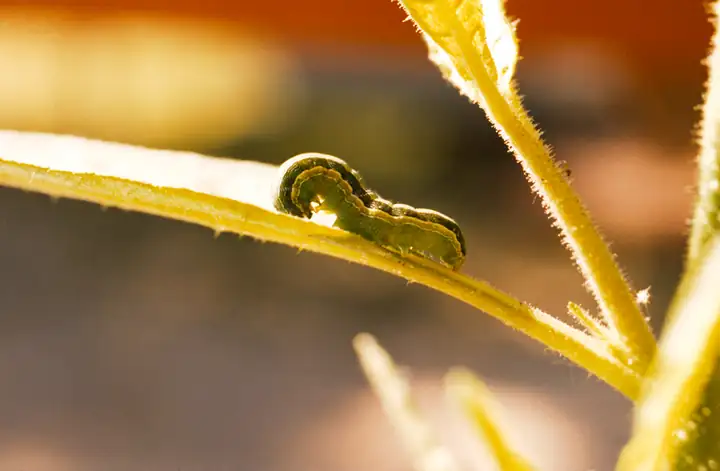
Beet armyworm
Spodoptera exigua
| Type | Insect |
|---|---|
| When | Summer and fall; year-round in the warmest areas. |
| Pressure by region | Moderate: Southeast, South Central, Southwest, California, Hawaii |
About
A green caterpillar, often with a white stripe along each side and a pinkish or yellowish underside, that feeds on a long list of vegetables. It lives year-round only in the warmest states but moves into the southern half of the country every year.
Spotting it
Damage
Young caterpillars skeletonize leaves, and older ones eat large, ragged holes. They can kill seedlings and stunt plants by feeding on the buds.
How to find it early
Look on leaves for fuzzy, cottony-looking egg masses of 50 to 150 eggs covered with whitish scales, and for patches of skeletonized leaf where tiny caterpillars are feeding.
When
Summer and fall; year-round in the warmest areas.
Life cycle
It overwinters mainly in Arizona, Florida and Texas and each year spreads into the southern half of the U.S., from Maryland to Colorado to northern California. In warm weather a generation can take as little as 24 days, and six generations have been raised in five summer months in Florida.
What to do, gentlest first
Start at the top. Sprays are a last step; always read and follow the product label.
Protect natural enemies Natural enemies
Parasitic wasps and tachinid flies, plus predators such as minute pirate bugs and bigeye bugs, attack beet armyworm. Avoid broad-spectrum sprays that kill them.
Bt (Bacillus thuringiensis) Natural enemies
UC IPM says Bt works best on newly hatched caterpillars, so spray as soon as you see egg masses hatching or small larvae.
Much less effective on larger caterpillars. Bt carries no bee warning on its label.
Spinosad Organic spray
Spinosad is an organically acceptable spray for beet armyworm (UC IPM).
Spinosad stays toxic to bees for about 3 hours to a day after spraying (PNW 591), not just while wet; spray in the evening when bees are not foraging, keep it off open flowers, and follow the label and pre-harvest interval.
Garden friends that go after it
Spined soldier bug
Protect these helpers: skip broad sprays when they're around.
Plants it goes after
Asparagus, Beet, Broccoli, Broccoli raab (rapini), Cabbage, Cauliflower, Celery, Eggplant, Green beans (snap beans), Lettuce, Napa cabbage, Onion, Peas, Pepper (sweet and chili), Potato, Radish, Southern peas, Spinach, Sweet corn, Sweet potato, Tomato, Turnip
Pressure by region
UF/IFAS says it overwinters in Arizona, Florida and Texas and invades the southern half of the country each year, so the South, Southwest and California are rated moderate. Hawaii's home-garden pest guide lists it among common pests (CTAHR). Northern, Mountain, Pacific Northwest and Alaska low ratings are estimates.
| Northeast | Low |
|---|---|
| Southeast | Moderate |
| South Central | Moderate |
| Midwest | Low |
| Great Plains | Low |
| Mountain West | Low |
| Southwest | Moderate |
| Pacific Northwest | Low |
| California | Moderate |
| Alaska | Low |
| Hawaii | Moderate |
Ratings come from extension sources where available; some are estimates, as noted above.
Sources
Photo: Photo: PLoS Biology (doi:10.1371/journal.pbio.0020250), CC BY 2.5, via Wikimedia Commons (CC BY 2.5). Photo resized for the web.

Planting dates and advice are general guidance; check with your local Cooperative Extension office for your area.