
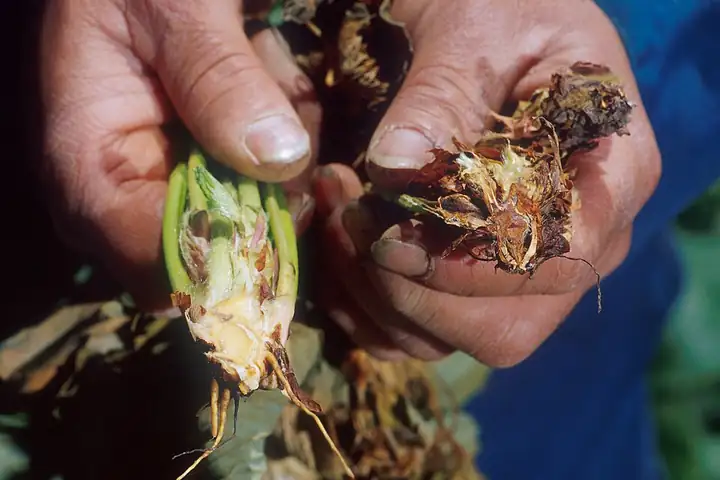
Verticillium wilt
Soil fungus (mainly Verticillium dahliae)
| Type | Fungus |
|---|---|
| Cause | Soil fungus (mainly Verticillium dahliae) |
| When | Late spring to midsummer; in brambles it shows by June or early July. |
About
Verticillium wilt is a soilborne disease that blocks the water-conducting tissue of a long list of plants, from tomatoes and potatoes to strawberries, brambles and many flowers. Its resting bodies last in soil for years, so avoiding infested ground and choosing resistant varieties are key.
Also called Verticillium wilt
How to recognize it
Symptoms
Older leaves yellow between the veins, often in a V shape, then wilt and die; wilting shows up on scattered branches or one side of the plant. Cutting the stem shows brown streaks in the water-conducting tissue. On black raspberries, a blue or purple streak may run up the cane from the soil.
Often confused with
Fusarium wilt looks nearly identical but favors warmer soil and tends to leave darker streaks; only a lab test tells them apart for sure.
Worse when
Cooler soils than Fusarium wilt, and fields with a history of tomatoes, potatoes, eggplant, peppers or strawberries.
How it spreads
The fungus survives for years in soil as tiny resting bodies (microsclerotia) and spreads with soil, infected plants and weeds such as horse nettle, ground cherry, pigweed and lamb's-quarters.
When
Late spring to midsummer; in brambles it shows by June or early July.
What to do, gentlest first
Prevention works best; most sprays only protect healthy leaves and can't cure infected ones. Always read and follow the product label.
Resistant varieties Prevent
Choose tomatoes marked V. For other crops, ask your Extension office which varieties hold up in your area.
Resistance is not immunity.
Plant in clean ground Prevent
Do not plant raspberries, blackberries or strawberries where tomatoes, potatoes, eggplant, peppers or strawberries grew recently, and buy certified disease-free stock.
Rotation, weeding and solarization Prevent
Rotate away from susceptible crops, control host weeds, and in hot sunny areas solarize the soil before planting.
Remove infected plants and roots By hand
Pull wilted plants with their roots and destroy them rather than composting.
No spray cures it Conventional spray
Penn State says there are no effective fungicides once plants are in the ground. Put your effort into prevention.
Plants it affects
Black raspberry (blackcap), Blackberry, Brussels sprouts, Cabbage, Cantaloupe (muskmelon), Cauliflower, Cherimoya, Chrysanthemum (garden mum), Cucumber, Eggplant, Ground cherry, Hops, Mango, Marigold, Okra, Pepper (sweet and chili), Potato, Raspberry, Strawberry, Sunflower, Tomatillo, Tomato, Watermelon, Winter squash and pumpkin, Zucchini and summer squash
Sources
Photo: Photo: Brian Prechtel, USDA ARS, Public domain (USDA ARS), via Wikimedia Commons. Photo resized for the web.

Planting dates and advice are general guidance; check with your local Cooperative Extension office for your area.