
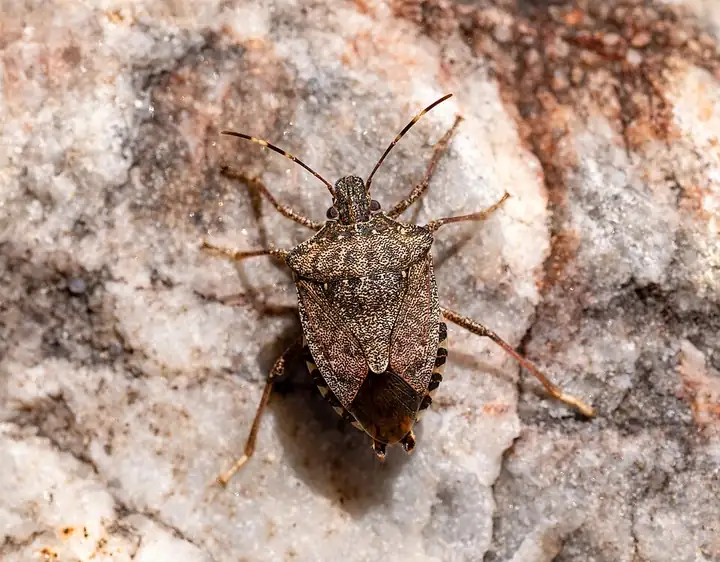
Stink bugs
Brown marmorated stink bug (Halyomorpha halys), native green stink bug (Chinavia hilaris) and southern green stink bug (Nezara viridula)
| Type | Insect |
|---|---|
| When | Midsummer through fall. |
| Pressure by region | High pressure: Northeast, Southeast |
About
Shield-shaped true bugs that suck juice from developing fruit and seeds. The invasive brown marmorated stink bug arrived in Pennsylvania by 1998 and has been detected in 47 states; the green species are native or long established.
Spotting it
Damage
Fruit gets dimples, pockmarks and cat-facing, and tomatoes and peppers develop hard or spongy, discolored patches inside. Bean and okra pods become scarred and deformed.
How to find it early
Check leaf undersides for tight egg clusters and small nymphs, and watch developing fruit for pinprick feeding spots.
When
Midsummer through fall.
Life cycle
Adults overwinter in leaf litter, under bark or, for the brown marmorated stink bug, inside houses, then lay egg clusters of 20 to 28 on leaf undersides. The brown marmorated and green stink bugs have one or two generations a year, and the southern green stink bug up to five in Texas.
What to do, gentlest first
Start at the top. Sprays are a last step; always read and follow the product label.
Seal the house Prevent
Caulk cracks around windows, doors and utility openings and fix screens to keep brown marmorated stink bugs from overwintering indoors.
Do not spray insecticide into wall voids; dead bugs attract carpet beetles.
Hand-pick and crush eggs By hand
Brush or shake bugs into soapy water and crush egg masses on leaf undersides.
Row cover Barrier
Cover vegetables to keep bugs off developing fruit.
Covers also keep out pollinators, so open them for crops that need bees.
Protect natural enemies Natural enemies
Assassin bugs, lacewing larvae, spiders and birds eat stink bugs, and a native tachinid fly (Trichopoda pennipes) parasitizes green stink bugs.
Garden insecticides (limited help) Conventional spray
UC IPM says most garden insecticides are not very effective against stink bugs, especially adults, and bugs reinvade after spraying.
Pheromone traps are for monitoring only and results vary. If you spray, avoid open flowers, and read and follow the label, including the pre-harvest interval.
Garden friends that go after it
Assassin bugs (incl. the wheel bug), Garden orb weavers (incl. yellow garden spider), Harvestmen (daddy longlegs), Spined soldier bug, Tachinid flies
Protect these helpers: skip broad sprays when they're around.
Plants it goes after
Apple (backyard tree), Aronia (black chokeberry), Barbados cherry (acerola), Blackberry, Blueberry, Dry beans (pinto, black, kidney, navy), Edamame, Eggplant, Grape, Green beans (snap beans), Jujube, Lima beans, Okra, Passion fruit, Peach, Peas, Pecan, Pepper (sweet and chili), Sesame, Southern peas, Starfruit (carambola), Sunflower, Sweet corn, Tomato
Pressure by region
The brown marmorated stink bug is worst in the mid-Atlantic, where it caused over $37 million in tree-fruit losses in 2010, and has also established on the West Coast. The southern green stink bug is a warm-climate species and is on Hawaii's home-garden pest list (CTAHR). No Alaska source was found, and the Great Plains, Mountain and Southwest have no regional severity source, so those low ratings are estimates.
| Northeast | High pressure |
|---|---|
| Southeast | High pressure |
| South Central | Moderate |
| Midwest | Moderate |
| Great Plains | Low |
| Mountain West | Low |
| Southwest | Low |
| Pacific Northwest | Moderate |
| California | Moderate |
| Alaska | Low |
| Hawaii | Moderate |
Ratings come from extension sources where available; some are estimates, as noted above.
Sources
- extension.psu.edu
- ipm.ucanr.edu
- ask.ifas.ufl.edu
- ask.ifas.ufl.edu
- texasinsects.tamu.edu
- stopbmsb.org
- www3.ctahr.hawaii.edu
Photo: Photo: Rhododendrites, CC BY-SA 4.0, via Wikimedia Commons (CC BY-SA 4.0). Photo resized for the web.

Planting dates and advice are general guidance; check with your local Cooperative Extension office for your area.