
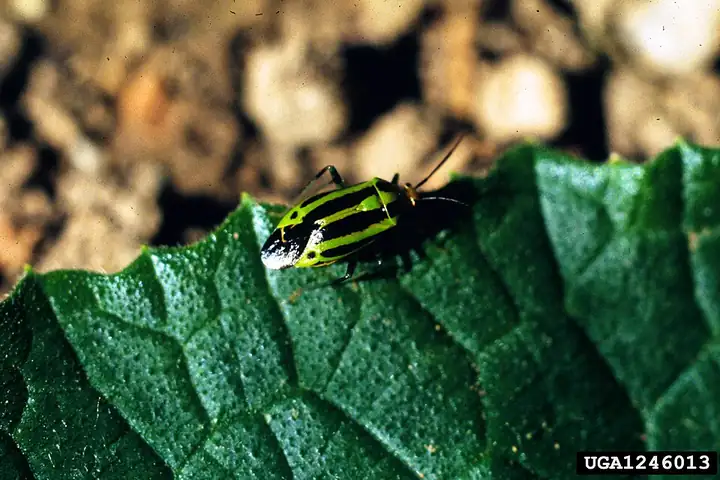
Four-lined plant bug
Poecilocapsus lineatus
| Type | Insect |
|---|---|
| Pressure by region | Moderate: Northeast, Southeast, Midwest |
About
A plant bug about 1/4 inch long (7 to 7.5 mm), yellow to green with four black stripes down its back; the nymphs are bright red to orange. It feeds on more than 250 kinds of plants, including mint-family herbs such as mint, sage, lavender and marjoram and daisy-family perennials (UF, NC State, UMass).
Spotting it
Damage
Feeding leaves sunken round or angular spots, 1/16 to 1/8 inch across, that turn dark or see-through. Spots can merge into blotches, the dead tissue can drop out and leave holes, and bad attacks wilt and curl shoot tips, though the damage is rarely fatal (NC State, UF, UMass).
How to find it early
In late spring, look for clusters of tiny dark or yellow spots on new leaves and for the red nymphs on top of the leaves (UMass, NC State).
When
Late spring to early summer; adults appear about late May in Pennsylvania and mid- to late June in New York (UF).
Life cycle
There is one generation a year. Eggs spend winter in slits in plant stems and hatch in spring; nymphs feed for about 3 to 6 weeks, and adults then feed for about a month (NC State, UMass).
What to do, gentlest first
Start at the top. Sprays are a last step; always read and follow the product label.
Accept some spotting Prevent
The damage is mostly cosmetic, so UF says sprays are rarely needed.
Cut back stems in fall Prevent
Cut perennials and herbs back at the end of the season and get rid of the stems, where eggs spend winter (UMass, UF).
Pick or wash them off By hand
Pick bugs off, wash them off with a spray of water, or prune infested shoot tips (UF).
Floating row cover Barrier
Row cover keeps the bugs off herbs and young plants (UF).
Natural enemies Natural enemies
A tiny parasitic wasp that attacks its eggs and a jumping spider feed on this bug (UF, UMass).
Insecticidal soap or horticultural oil Organic spray
NC State recommends insecticidal soap or horticultural oil. Spray the bugs directly, since these work only on contact.
Soap and oil work only on contact. Oil can harm bees it hits for up to about 3 hours (PNW 591), so spray when bees are not on the plants. Some guides list neonicotinoids; they harm pollinators, so skip them. On herbs you eat, follow the label's pre-harvest interval. Read and follow the label.
Plants it goes after
Azalea, Blanket flower (gaillardia), Chrysanthemum (garden mum), Coreopsis (tickseed), Dahlia, Feverfew, Forsythia, Garden phlox (tall phlox), Lavender (English), Lemon balm, Lupine (and Texas bluebonnet), Mint, Monkshood, Oregano, Peony, Rose (garden and landscape roses), Sage, Shasta daisy, Snapdragon, Sunflower, Sweet marjoram, Thyme, Weigela, Zinnia
Pressure by region
UF says it is common through most of the eastern and Midwestern US and is found south into Florida, but its range west of the Rocky Mountains is not known. Ratings for the West, the south-central and Plains states, Alaska and Hawaii are estimates.
| Northeast | Moderate |
|---|---|
| Southeast | Moderate |
| South Central | Low |
| Midwest | Moderate |
| Great Plains | Low |
| Mountain West | Low |
| Southwest | Low |
| Pacific Northwest | Low |
| California | Low |
| Alaska | Low |
| Hawaii | Low |
Ratings come from extension sources where available; some are estimates, as noted above.
Sources
Photo: Photo: Whitney Cranshaw, Colorado State University, Bugwood.org, CC BY 3.0 US, via Wikimedia Commons (CC BY 3.0 US). Photo resized for the web.

Planting dates and advice are general guidance; check with your local Cooperative Extension office for your area.