
Birds
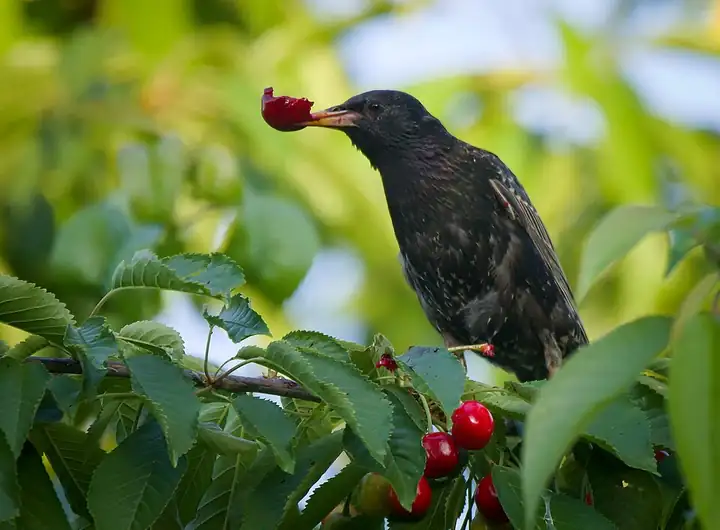
Many species, such as the American robin (Turdus migratorius), European starling (Sturnus vulgaris), American crow (Corvus brachyrhynchos), house finch, scrub jays and crowned sparrows
| Type | Bird |
|---|---|
| When | Spring for seedlings and buds; whenever fruit ripens, earliest fruits first. |
| Pressure by region | Moderate: all regions |
About
Birds eat ripening fruit, flower buds and the first leaves of emerging seedlings. Most native birds, including robins, finches, jays and crows, are protected by the federal Migratory Bird Treaty Act, so gardeners should rely on netting and scare tactics.
Spotting it
Damage
Fruit is pecked open, sometimes down to the pit, and seedlings can lose their seed leaves soon after coming up. Early-ripening fruit such as cherries is hit hardest, and starlings often feed in large flocks on ripening fruit.
How to find it early
Watch the garden early in the day as fruit starts to color and as seedlings come up, and look for pecked fruit and bare seedling stems.
When
Spring for seedlings and buds; whenever fruit ripens, earliest fruits first.
Life cycle
Some garden birds, such as American robins, are migratory, while others stay year-round. Damage is often worst near brushy or wild areas where birds shelter.
What to do, gentlest first
Start at the top. Sprays are a last step; always read and follow the product label.
Bird netting Barrier
Netting is the most effective way to protect small plantings. Use plastic netting with 1/4- to 1/2-inch mesh on a frame that holds it away from the plant, so birds cannot reach fruit through it at the edges.
Anchor the edges so birds cannot get underneath, and check netting often so no bird gets tangled.
Do not trap or harm protected birds Trap
Under the Migratory Bird Treaty Act, killing, capturing or otherwise taking protected migratory birds requires prior authorization from the U.S. Fish and Wildlife Service. Non-native birds such as European starlings are not covered by the Act, but netting and scare tactics are still the right approach for gardeners.
State laws may also protect birds; check with your state wildlife agency.
Scare devices, rotated often Repellent
Combine sound devices with visual ones such as Mylar streamers or scare-eye balloons, and switch to a different combination at least every week.
Crows, jays and magpies can learn to ignore noisemakers within hours, so do not count on scare devices alone.
Methyl anthranilate sprays Repellent
Some bird repellents for fruit contain methyl anthranilate; UC IPM reports variable results.
Use only products labeled for food crops if you spray anything you will eat, and follow the label. Keep children and pets off treated plants until the spray dries.
Plants it goes after
Apple (backyard tree), Aronia (black chokeberry), Barbados cherry (acerola), Beach plum, Blueberry, Buffaloberry (silver buffaloberry), Cherry (sweet and tart), Chokecherry, Cornelian cherry, Dragon fruit (pitaya), Elderberry (American), Fig, Grape, Haskap (honeyberry), Huckleberry (western mountain huckleberry), Jaboticaba, Jujube, Lingonberry, Mayhaw, Mulberry (red and black), Nanking cherry, Pecan, Serviceberry (juneberry, saskatoon), Starfruit (carambola), Tejocote (Mexican hawthorn), Thimbleberry
Pressure by region
Birds damage gardens in every region, including Hawaii, where they feed on fruit, flower buds and seedlings (CTAHR). No regional severity source was found, so these ratings are estimates.
| Northeast | Moderate |
|---|---|
| Southeast | Moderate |
| South Central | Moderate |
| Midwest | Moderate |
| Great Plains | Moderate |
| Mountain West | Moderate |
| Southwest | Moderate |
| Pacific Northwest | Moderate |
| California | Moderate |
| Alaska | Moderate |
| Hawaii | Moderate |
Ratings come from extension sources where available; some are estimates, as noted above.
Sources
Photo: Photo: hedera.baltica, CC BY-SA 2.0, via Wikimedia Commons (CC BY-SA 2.0). Photo resized for the web.

Planting dates and advice are general guidance; check with your local Cooperative Extension office for your area.