
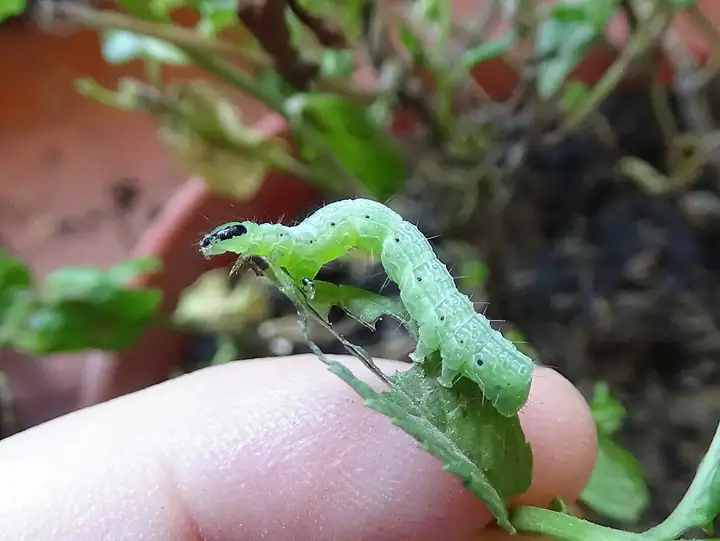
Cabbage looper
Trichoplusia ni
| Type | Insect |
|---|---|
| Pressure by region | Moderate: Southeast, South Central, Southwest, California, Hawaii |
About
A pale green caterpillar with white side stripes, up to an inch and a half long, that arches its back into a loop as it walks. The adult is a mottled gray-brown night moth with a small silvery figure-8 on each front wing.
Spotting it
Damage
Young caterpillars feed on leaf undersides; older ones chew large ragged holes and may bore into cabbage heads, leaving droppings. A caterpillar eats about three times its weight in leaves a day.
How to find it early
Check leaf undersides for tiny creamy-white, aspirin-shaped eggs and small green loopers, especially on the outer leaves.
When
Midsummer to fall in the North (moths reach Minnesota early July through late August); much longer in the South and California.
Life cycle
It overwinters only in the southernmost states and reinvades the North each year. There are two to three generations in Canada, one to three in Minnesota, five in North Carolina and five to seven in California.
What to do, gentlest first
Start at the top. Sprays are a last step; always read and follow the product label.
Hand-pick By hand
Drop loopers into soapy water.
Floating row cover Barrier
Cover cabbage-family crops at planting to keep moths from laying eggs.
Natural enemies Natural enemies
Parasitic wasps, tachinid flies and a virus disease kill many loopers; avoid broad-spectrum sprays that wipe them out.
Bt (Bacillus thuringiensis) Natural enemies
Spray small larvae with Bt and cover the leaves well.
Less effective on large loopers.
Spinosad Organic spray
Spinosad makes caterpillars stop feeding and they die soon after.
Toxic to bees while wet; spray in the evening when bees are not foraging, keep it off open flowers, and follow the label and pre-harvest interval.
Broad-spectrum insecticides Conventional spray
Available for heavy infestations.
Many are highly toxic to bees and they also kill the natural enemies. Keep sprays off open flowers and follow the label and pre-harvest interval.
Garden friends that go after it
Spined soldier bug, Tachinid flies, Trichogramma wasps
Protect these helpers: skip broad sprays when they're around.
Plants it goes after
Bok choy, Broccoli, Broccoli raab (rapini), Brussels sprouts, Cabbage, Cauliflower, Celeriac, Chickpea, Collards, Green beans (snap beans), Kale, Kohlrabi, Larkspur (annual larkspur), Lettuce, Mâche (corn salad), Napa cabbage, Ornamental kale and cabbage, Pepper (sweet and chili), Radicchio, Rutabaga, Southern peas, Statice (annual statice), Tomato
Pressure by region
Overwinters only in the warmest zones; in Florida it stays active year-round only south of Orlando. Northern gardens get migrant moths from midsummer, so spring crops there usually face less pressure; northern regions are rated low rather than moderate for that reason. No Alaska source was found, so Alaska's rating is an estimate.
| Northeast | Low |
|---|---|
| Southeast | Moderate |
| South Central | Moderate |
| Midwest | Low |
| Great Plains | Low |
| Mountain West | Low |
| Southwest | Moderate |
| Pacific Northwest | Low |
| California | Moderate |
| Alaska | Low |
| Hawaii | Moderate |
Ratings come from extension sources where available; some are estimates, as noted above.
Sources
Photo: Photo: Lua Eva Blue, CC BY 3.0, via Wikimedia Commons (CC BY 3.0). Photo resized for the web.

Planting dates and advice are general guidance; check with your local Cooperative Extension office for your area.