
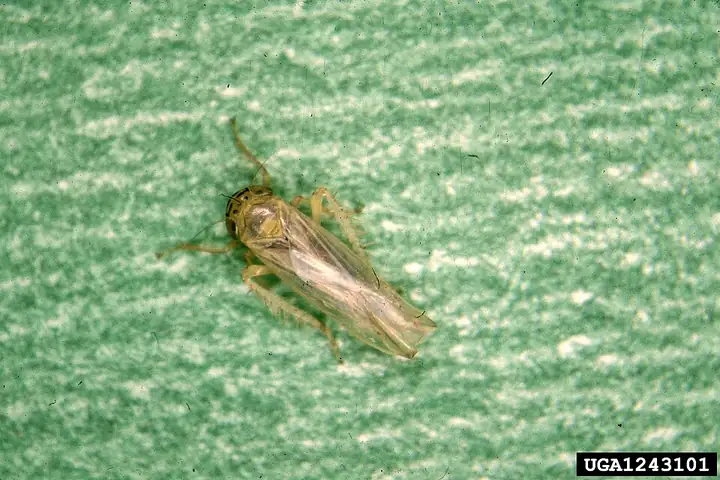
Leafhoppers
Family Cicadellidae (more than 2,500 species in North America), including the aster leafhopper, beet leafhopper, grape leafhoppers, rose leafhopper, sage or mint leafhopper (Eupteryx melissae) and the potato leafhopper (Empoasca fabae), which has its own page
| Type | Insect |
|---|---|
| When | Late spring through fall; all stages can be found year-round in mild climates. |
| Pressure by region | Moderate: Northeast, Southeast, South Central, Midwest, Great Plains, Mountain West, Southwest, Pacific Northwest, California |
About
Small, wedge-shaped insects, usually under 1/4 inch, that hop away or scuttle sideways when disturbed and suck sap from leaves. Most cause only cosmetic speckling, but a few spread plant diseases, such as aster yellows (aster leafhopper) and curly top (beet leafhopper) (UC IPM, UConn).
Spotting it
Damage
Feeding leaves pale stippling, like tiny bleached dots, that can spread until leaves yellow, brown or curl, and nymphs leave white cast skins under the leaves. Some species drip sticky honeydew that grows black sooty mold (UC IPM). Aster leafhoppers spread aster yellows, which leaves carrots stunted, pale and covered in hairy roots and turns lettuce yellow and twisted (Illinois).
How to find it early
Turn leaves over and look for quick, wedge-shaped insects running sideways, plus pale nymphs and white cast skins; yellow sticky cards also catch them. Stippling can look like spider mite, lace bug or thrips damage, so find the insect before you treat (UC IPM, UConn).
When
Late spring through fall; all stages can be found year-round in mild climates.
Life cycle
Females slip eggs into leaves and stems, and nymphs molt five times with no pupal stage; most species spend winter as eggs and have two or more generations a year (UC IPM). Many aster leafhoppers arrive each spring from southern states, and potato leafhoppers overwinter only in the warm Southeast (Illinois, UConn).
What to do, gentlest first
Start at the top. Sprays are a last step; always read and follow the product label.
Tolerate light speckling Prevent
In most gardens leafhoppers are a nuisance, not a threat to the plant, and control usually isn't needed (UC IPM).
Pull weeds and diseased plants Prevent
Remove nearby weeds that host leafhoppers, and pull and destroy plants infected with aster yellows (UC IPM, Illinois).
Row cover Barrier
Cover carrots, lettuce and other crops with row cover to keep aster leafhoppers off (Illinois).
Natural enemies Natural enemies
Assassin bugs, lacewings, damsel bugs, lady beetles, minute pirate bugs, spiders and tiny wasps that attack leafhopper eggs all help keep them in check (UC IPM).
Insecticidal soap, horticultural oil or neem oil Organic spray
When nymphs are plentiful early in the season, spray leaf undersides and green shoots thoroughly with insecticidal soap, horticultural oil or neem oil (UC IPM).
These work only on contact, and winged adults fly back in (UConn). Sprays don't prevent leafhopper-spread diseases, because the insects can pass on the disease before they die (UC IPM). Oil can harm bees for up to about 3 hours (PNW 591), so spray when bees aren't visiting, and follow the label.
Plants it goes after
Anise, Apple (backyard tree), Aster, Baby's breath, Carrot, Celeriac, Coreopsis (tickseed), Dry beans (pinto, black, kidney, navy), Eastern redbud, Eggplant, Endive and escarole, Flowering cherry, Flowering dogwood, Flowering tobacco (nicotiana), Grape, Green beans (snap beans), Hazelnut (filbert), Hops, Japanese maple, Kousa dogwood, Lettuce, Mamey sapote, Medlar, Mint, Potato, Purple coneflower (echinacea), Red maple, Rose (garden and landscape roses), Rosemary, Sage, Strawflower, Yacon
Pressure by region
Leafhoppers live in every region; California alone has more than 380 species (UC IPM). No source rated them by region, so ratings are estimates. See the potato leafhopper page for that eastern pest, which overwinters in the Gulf states.
| Northeast | Moderate |
|---|---|
| Southeast | Moderate |
| South Central | Moderate |
| Midwest | Moderate |
| Great Plains | Moderate |
| Mountain West | Moderate |
| Southwest | Moderate |
| Pacific Northwest | Moderate |
| California | Moderate |
| Alaska | Low |
| Hawaii | Low |
Ratings come from extension sources where available; some are estimates, as noted above.
Sources
Photo: Photo: Whitney Cranshaw / Wikimedia Commons, CC BY 3.0 US (CC BY 3.0 US). Photo resized for the web.

Planting dates and advice are general guidance; check with your local Cooperative Extension office for your area.