
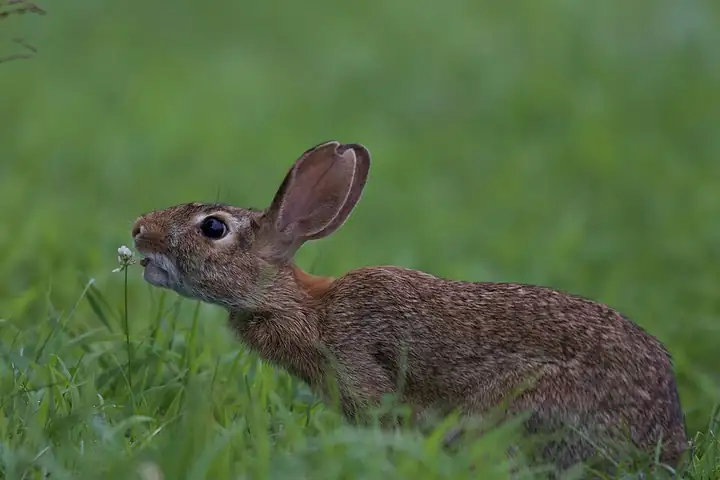
Rabbits
Eastern cottontail (Sylvilagus floridanus) and other cottontails; brush rabbits and black-tailed jackrabbits (Lepus californicus) in the West
| Type | Animal |
|---|---|
| When | Year-round; garden damage in the growing season, bark and twig damage in winter. |
| Pressure by region | Moderate: Northeast, Southeast, South Central, Midwest, Great Plains, Mountain West, Southwest, Pacific Northwest, California |
About
Cottontails nibble tender vegetables and flowers in the growing season and gnaw bark and twigs of young trees and shrubs in winter. Damage is usually worst near brush piles, brambles and other places where they hide.
Spotting it
Damage
Rabbits snip stems and twigs off cleanly at a sharp 45-degree angle, as if cut with scissors; deer leave ragged, torn ends. Round droppings, about 1/4 inch across for cottontails, are another sign.
How to find it early
Check low plants early in the morning for neatly clipped stems and seedlings, and look for small round droppings nearby.
When
Year-round; garden damage in the growing season, bark and twig damage in winter.
Life cycle
Cottontails can raise up to six litters a year of about three or four young each. They feed mostly from evening through the night into early morning, within a home range of up to 10 to 15 acres.
What to do, gentlest first
Start at the top. Sprays are a last step; always read and follow the product label.
Remove hiding places Prevent
Clear brush piles, brambles, stone piles and other debris near the garden where rabbits hide.
Low wire fence Barrier
A fence 2 feet tall keeps cottontails out during the growing season (use 3 feet for jackrabbits). Use wire with mesh 1 inch or smaller, and bury the bottom or bend it outward so they cannot dig under; UC IPM suggests burying it 6 to 10 inches.
For winter protection of trees and shrubs, Iowa State suggests 24 to 36 inches tall so rabbits cannot reach over on snow.
Tree guards Barrier
Wrap young tree trunks with cylinders of 1-inch poultry netting, set 2 to 3 inches into the soil, or with plastic tree guards.
Check guards after heavy snow, which can let rabbits reach above them.
Live trapping is regulated Trap
Rabbits are game animals in most states, and many states restrict trapping and releasing them elsewhere; California, for example, makes it illegal to release trapped rabbits in other areas without a permit.
Trapping and relocating wildlife is regulated by state law, and the rules differ from state to state. Check with your state wildlife agency before you set a trap.
Blood- or egg-based repellents Repellent
Repellents with dried blood or rotten egg solids can reduce browsing on trees and ornamentals, but UC IPM says they usually fail in vegetable gardens, and rabbits can get used to them. Reapply after rain and on new growth.
Use only products labeled for food crops if you spray anything you will eat, and follow the label. Keep children and pets off treated plants until the spray dries.
Plants it goes after
American plum (wild plum), Anise hyssop, Apple (backyard tree), Aronia (black chokeberry), Aster, Cabbage, Carrot, Chestnut, Creeping phlox (moss phlox), Crocus, Fig, Goumi, Hosta (plantain lily), Jujube, Lettuce, Marigold, Mayhaw, Nanking cherry, Pear, Raspberry, Roselle (Florida cranberry), Saffron crocus, Salmonberry, Scarlet runner bean, Spiderwort, Statice (annual statice), Tulip, Winterberry
Pressure by region
The eastern cottontail ranges from southern New England west to eastern Montana and south into Mexico; desert and mountain cottontails are common farther west, and California also has brush rabbits and jackrabbits. No regional severity source was found, so the moderate ratings are estimates; no Alaska or Hawaii source was found, so those low ratings are estimates too.
| Northeast | Moderate |
|---|---|
| Southeast | Moderate |
| South Central | Moderate |
| Midwest | Moderate |
| Great Plains | Moderate |
| Mountain West | Moderate |
| Southwest | Moderate |
| Pacific Northwest | Moderate |
| California | Moderate |
| Alaska | Low |
| Hawaii | Low |
Ratings come from extension sources where available; some are estimates, as noted above.
Sources
Photo: Photo: Grayson Smith, USFWS, Public domain (USFWS), via Wikimedia Commons. Photo resized for the web.

Planting dates and advice are general guidance; check with your local Cooperative Extension office for your area.