
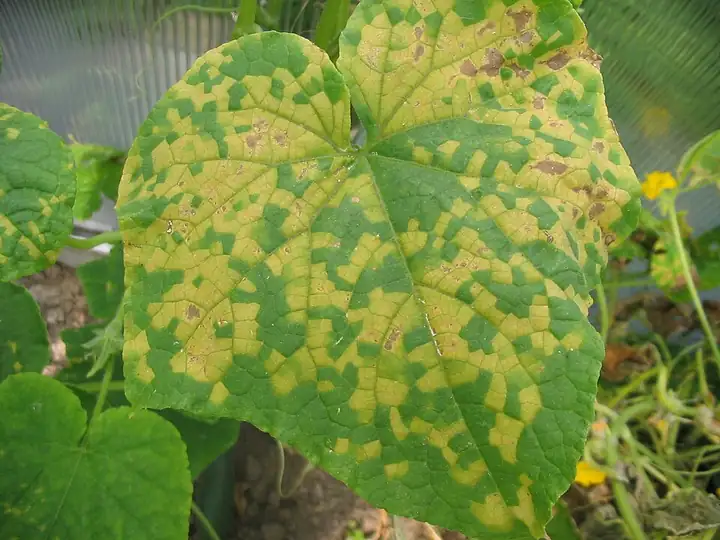
Downy mildew
Water molds, each specific to certain crops (for example Pseudoperonospora cubensis on cucurbits, Peronospora farinosa f. sp. spinaciae on spinach, Peronospora parasitica on cabbage-family crops)
| Type | Water mold |
|---|---|
| Cause | Water molds, each specific to certain crops (for example Pseudoperonospora cubensis on cucurbits, Peronospora farinosa f. sp. spinaciae on spinach, Peronospora parasitica on cabbage-family crops) |
About
Downy mildews are fast-moving leaf diseases of cucurbits, spinach, lettuce, cabbage-family crops, grapes and more, and Penn State warns they can kill plants within about a week. They are water molds, not true fungi, so many ordinary fungicides do not work on them.
Also called downy mildew, cucurbit downy mildew
How to recognize it
Symptoms
Pale green to yellow spots show on the top of the leaf, often angular because leaf veins box them in; underneath, a gray, white or purplish fuzz appears, best seen early in the morning after a damp night. Spots turn brown and dry, and whole leaves wither. Broccoli and cauliflower can get black streaks inside the stems and heads.
Often confused with
Powdery mildew grows as white powder on top of the leaf; downy mildew's fuzz is on the underside, below yellow spots.
Worse when
Cool to mild, humid weather (roughly 58 to 78°F) with wet leaves from rain, fog, dew or sprinklers.
How it spreads
Spores blow on the wind and splash in water; some kinds survive in crop debris and weeds, while cucurbit downy mildew cannot overwinter in the North and blows in from the South each summer.
When
Cool, wet spells: spring and fall for spinach, lettuce and cabbage-family crops; mid to late summer for cucurbits (usually by August in the East, UMN).
Where
Cucurbit downy mildew survives winter only in warm southern areas and moves north on the wind during summer (UMN, Penn State).
What to do, gentlest first
Prevention works best; most sprays only protect healthy leaves and can't cure infected ones. Always read and follow the product label.
Resistant varieties Prevent
Resistant varieties are available for cucumber, spinach and broccoli.
Keep leaves dry Prevent
Space and trellis plants, use drip or water early so leaves dry fast, use raised beds for greens, and time spinach and cole crops to avoid the coolest, wettest weeks.
Watch the forecast maps Prevent
For cucurbits, UMN suggests checking the cucurbit downy mildew forecasting map (the CDM ipmPIPE) to see when it is getting close.
Remove infected plants and debris By hand
Pull infected plants or leaves and destroy them instead of composting, and remove weeds that can host the disease.
Copper Organic spray
Clemson lists copper as a preventive option for cucurbit downy mildew; it must be on the leaves before spores arrive.
Copper only protects leaves it coats before infection; it will not heal spots already there. It can burn young leaves, especially in weather above 85°F, and some plants are sensitive (Purdue lists celery, strawberry, apple, pear and plum among them). PNW 591 rates copper hydroxide toxic to bees, so spray when bees are not foraging. Follow the label, including the days to wait before harvest.
Chlorothalonil and water-mold fungicides Conventional spray
Clemson lists chlorothalonil as a preventive for cucurbits; other products must be ones labeled for water molds. Rotate chemical groups, since resistance is common.
Chlorothalonil is a protectant: it keeps new infections from starting but does not cure existing spots. UC IPM rates it highly hazardous to fish and other aquatic life, and product labels carry a DANGER signal word. Keep it out of water and off flowering plants, wear gloves and eye protection, and follow the label and pre-harvest interval.
Plants it affects
Black-eyed Susan, Bok choy, Broccoli, Cabbage, Cantaloupe (muskmelon), Cauliflower, Chives, Collards, Cucumber, Endive and escarole, Epazote, Grape, Hellebore (Lenten rose), Hops, Kale, Lettuce, Luffa (loofah gourd), Napa cabbage, Pansy and viola, Poppy (Oriental, Iceland, corn and breadseed poppies), Radish, Scabiosa (pincushion flower), Shallot, Spinach, Strawflower, Sunflower, Watermelon, Winter squash and pumpkin, Zucchini and summer squash
Sources
- extension.umn.edu
- extension.psu.edu
- ipm.ucanr.edu
- ipm.ucanr.edu
- vegetables.cornell.edu
- hgic.clemson.edu
- ipm.ucanr.edu
- extension.purdue.edu
- s3.wp.wsu.edu
Photo: Photo: Christian Hummert, CC BY-SA 3.0, via Wikimedia Commons (CC BY-SA 3.0). Photo resized for the web.

Planting dates and advice are general guidance; check with your local Cooperative Extension office for your area.