
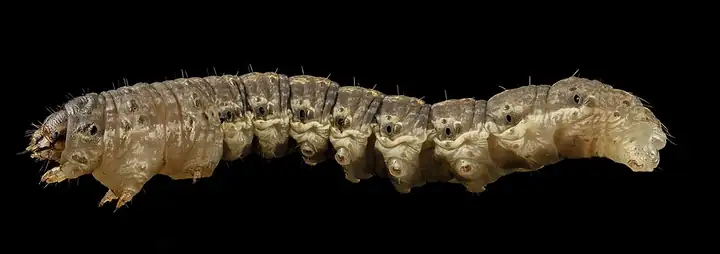
Cutworms
Caterpillars of several night-flying moths, most often the black cutworm (Agrotis ipsilon); also variegated, dingy, bronzed and army cutworms
| Type | Insect |
|---|---|
| When | Spring, while plants are small; they are rarely a problem after spring. |
| Pressure by region | Moderate: Northeast, Southeast, South Central, Midwest, Great Plains, Mountain West, Southwest, Pacific Northwest, California, Hawaii |
About
Cutworms are smooth, greasy-looking caterpillars up to two inches long that curl into a tight C when disturbed. They hide in the soil by day and feed at night.
Spotting it
Damage
Seedlings and new transplants are chewed off at the soil line overnight, with droppings on the soil nearby. Variegated cutworms climb and eat leaves, buds and fruit instead.
How to find it early
The morning after a plant is cut, dig through the top inch of soil around the stump; the caterpillar is rarely far away. You can also scout by flashlight at dusk.
When
Spring, while plants are small; they are rarely a problem after spring.
Life cycle
Most species have up to three generations a year, and the spring one does the most damage. Black and variegated cutworms migrate north each spring from the Gulf Coast, while dingy, bronzed and glassy cutworms overwinter locally as eggs or larvae in weedy, grassy ground.
What to do, gentlest first
Start at the top. Sprays are a last step; always read and follow the product label.
Clean up and till Prevent
Remove weeds and plant debris, and till before planting and again in fall. Keep a 3-4 foot strip of bare, dry soil around beds, and end cover crops early or use compost instead of green manure.
Dig and pick By hand
Search the soil around cut plants, or go out with a flashlight after dark, and destroy any cutworms you find.
Stem collars Barrier
Push a cardboard or aluminum-foil collar around each transplant stem, with one end a few inches into the soil and the other several inches above ground.
Bt (Bacillus thuringiensis) Natural enemies
Spray Bt on vegetable plants where cutworms are feeding.
Spinosad Organic spray
Spinosad sprays are another option for cutworms on vegetables.
Toxic to bees while wet; spray in the evening, keep it off open flowers, and follow the label and pre-harvest interval.
Labeled insecticides Conventional spray
Products labeled for cutworms on your crop work best applied late in the day, since cutworms feed at night.
UC IPM notes pesticides are not very effective here, so collars and cleanup come first. Many garden insecticides are highly toxic to bees, so keep them off open flowers. Follow the label and pre-harvest interval.
Garden friends that go after it
Big-eyed bugs, Fireflies (lightning bugs)
Protect these helpers: skip broad sprays when they're around.
Plants it goes after
Amaranth (greens), Anemone (windflower), Asparagus, Broccoli raab (rapini), Cabbage, Carrot, Celeriac, Chickpea, Cilantro (coriander), Dry beans (pinto, black, kidney, navy), Eggplant, Garlic, Green beans (snap beans), Ground cherry, Hops, Larkspur (annual larkspur), Lentil, Lettuce, Napa cabbage, Pansy and viola, Peanut, Peas, Pepper (sweet and chili), Potato, Radicchio, Rutabaga, Spinach, Statice (annual statice), Sweet corn, Sweet potato, Swiss chard, Tatsoi, Tomatillo, Tomato, Yacon
Pressure by region
Black cutworm spends winter mainly along the Gulf Coast and rides storm fronts north from February, heaviest in April and May, so northern gardens are hit by migrants. The black cutworm is on Hawaii's home-garden pest list (CTAHR). No Alaska source was found, so Alaska's low rating is an estimate.
| Northeast | Moderate |
|---|---|
| Southeast | Moderate |
| South Central | Moderate |
| Midwest | Moderate |
| Great Plains | Moderate |
| Mountain West | Moderate |
| Southwest | Moderate |
| Pacific Northwest | Moderate |
| California | Moderate |
| Alaska | Low |
| Hawaii | Moderate |
Ratings come from extension sources where available; some are estimates, as noted above.
Sources
Photo: Photo: USGS Bee Inventory and Monitoring Lab, Public domain (USGS), via Wikimedia Commons. Photo resized for the web.

Planting dates and advice are general guidance; check with your local Cooperative Extension office for your area.