
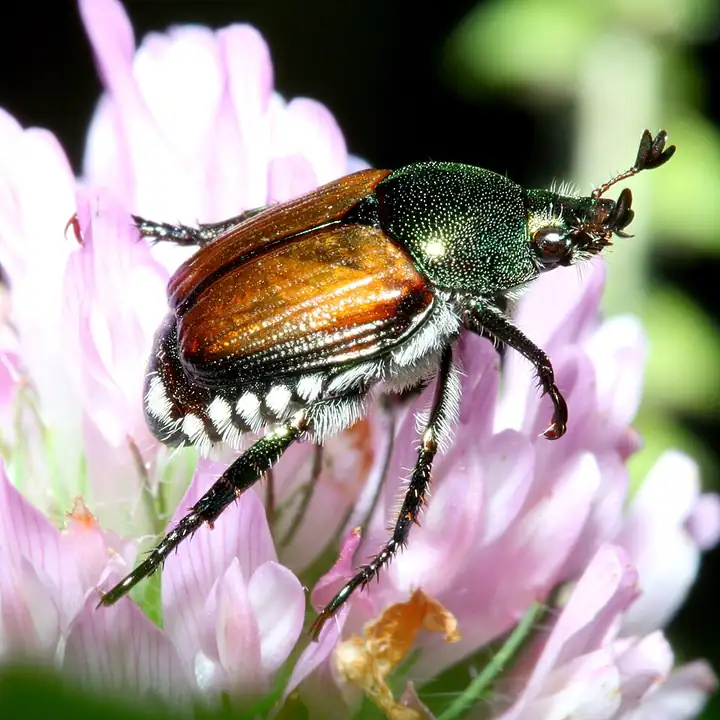
Japanese beetle
Popillia japonica
| Type | Insect |
|---|---|
| When | Summer, mainly July and August. |
| Pressure by region | High pressure: Northeast, Southeast, Midwest |
About
A three-eighths-inch beetle with a metallic green head, copper-brown wing covers and white hair tufts along its sides. The adults feed on hundreds of plants, and the young are white grubs in lawns.
Spotting it
Damage
Beetles skeletonize leaves, eating the tissue between the veins and leaving lace, and they also chew flowers. They feed in clusters because feeding beetles attract more.
How to find it early
Start checking roses, grapes, raspberries and beans in late June (May in the South), and watch for browning lawn patches in August from the grubs.
When
Summer, mainly July and August.
Life cycle
Adults emerge in early summer and females lay eggs in turf through July and August; the grubs feed on grass roots, dig deeper for winter, then come back up in spring to pupate. There is one generation a year.
What to do, gentlest first
Start at the top. Sprays are a last step; always read and follow the product label.
Choose less-favored plants Prevent
Plants such as boxwood, conifers, magnolia and oak are rarely eaten. Near lawns, mow high and let the soil surface dry in July and August when females lay eggs.
Shake into soapy water By hand
In the cool of early morning or evening, shake or knock beetles into a bucket of soapy water; they drop when disturbed.
Do not hang Japanese beetle traps. Research shows they pull in more beetles than they catch, so damage nearby goes up.
Fine netting Barrier
Drape fine netting over prized plants during peak weeks.
Do not cover plants in bloom that need pollinators.
Nematodes for the grubs Natural enemies
Heterorhabditis nematodes attack the grubs in the soil.
UMN says nematode results are inconsistent, and commercial milky spore has not shown any benefit in modern university trials.
Bt galleriae, neem or pyrethrins Organic spray
Bacillus thuringiensis var. galleriae protects for one to two weeks and does not harm bees. Neem and pyrethrins need repeat sprays.
Pyrethrins are highly toxic to bees and neem is short-lived, so spray them in the evening and not on open flowers. Follow the label and pre-harvest interval.
Chlorantraniliprole; other insecticides with care Conventional spray
Chlorantraniliprole lasts two to four weeks and is low risk to bees (UMN). Use it on grapes, raspberries or beans only if the product label lists that crop.
Pyrethroids, carbaryl and neonicotinoids such as imidacloprid are toxic to bees; never apply them to flowering plants, and do not use systemic neonicotinoids on food crops. Follow the label and pre-harvest interval.
Garden friends that go after it
Tachinid flies
Protect these helpers: skip broad sprays when they're around.
Plants it goes after
Apothecary rose, Aronia (black chokeberry), Astilbe (false spirea), Basil, Beach plum, Black raspberry (blackcap), Black-eyed Susan, Blackberry, Buckeye, Calla lily, Canna, Coral bells (heuchera), Eastern redbud, Elderberry (American), Flowering cherry, Flowering crabapple, Foxglove, Grape, Green beans (snap beans), Hardy hibiscus (rose mallow), Hardy kiwi (kiwiberry), Hazelnut (filbert), Hollyhock, Holy basil (tulsi), Hops, Lavatera (annual mallow), Linden, Ornamental sweet potato vine, Pear, Peony, Perilla (shiso), Purple coneflower (echinacea), Raspberry, Rose (garden and landscape roses), Rose of Sharon (shrub althea), Sassafras, Scarlet runner bean, Sea buckthorn (seaberry), Switchgrass, Sycamore, Witch hazel
Pressure by region
Established through most of the U.S. east of the Mississippi and generally in Arkansas, Iowa and Missouri; only partly in Kansas, Minnesota, Nebraska, Oklahoma, South Dakota and Texas (APHIS). Western states are protected by quarantine, but Colorado has permanent populations on the Front Range and near Palisade, and Washington is treating properties in Yakima, Benton, Franklin and King counties in 2026. It is not established in California and not present in Hawaii (Hawaii Invasive Species Council, 2024). No Alaska source was found, so Alaska's low rating is an estimate.
| Northeast | High pressure |
|---|---|
| Southeast | High pressure |
| South Central | Moderate |
| Midwest | High pressure |
| Great Plains | Low |
| Mountain West | Low |
| Southwest | Low |
| Pacific Northwest | Low |
| California | Not found here |
| Alaska | Low |
| Hawaii | Not found here |
Ratings come from extension sources where available; some are estimates, as noted above.
Sources
- extension.umn.edu
- extension.colostate.edu
- aphis.usda.gov
- invasivespeciesinfo.gov
- dlnr.hawaii.gov
- pnwag.net
- extension.psu.edu
- s3.wp.wsu.edu
Photo: Photo: Bruce Marlin, CC BY 3.0, via Wikimedia Commons (CC BY 3.0). Photo resized for the web.

Planting dates and advice are general guidance; check with your local Cooperative Extension office for your area.