
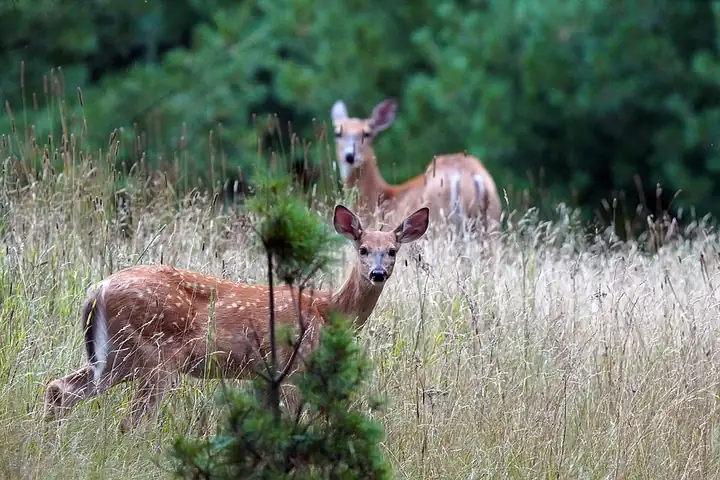
Deer
White-tailed deer (Odocoileus virginianus); mule deer and black-tailed deer (Odocoileus hemionus) in the West
| Type | Animal |
|---|---|
| When | Year-round; antler rubbing on trees from late summer through fall. |
| Pressure by region | Moderate: Northeast, Southeast, South Central, Midwest, Great Plains, Mountain West, Southwest, Pacific Northwest, California |
About
Deer browse buds, leaves, fruit and vegetables, and a hungry deer will eat almost any plant, so no plant is truly deer-proof. White-tailed deer are widespread, while mule deer and black-tailed deer are the deer of California, and Montana has both white-tailed and mule deer.
Spotting it
Damage
Deer have no upper front teeth, so they tear plants and leave ragged, shredded ends, unlike the clean, angled cut a rabbit leaves. Browsing reaches about 4 to 6 feet high, and bucks rub bark off tree trunks and limbs with their antlers from late summer through fall.
How to find it early
Look for split, pointed hoofprints 2 to 3 inches long, piles of jellybean-shaped droppings, and torn-off tops of plants.
When
Year-round; antler rubbing on trees from late summer through fall.
Life cycle
Deer feed mostly in the late evening and very early morning, browsing buds, leaves, fruit and garden vegetables. Damage gets worse when other food is scarce or deer numbers are high.
What to do, gentlest first
Start at the top. Sprays are a last step; always read and follow the product label.
Pick less-favored plants Prevent
Deer prefer some plants over others, but preferences vary by region and a hungry deer eats almost anything. Treat plant choice as a help, not a cure.
Tall woven-wire fence Barrier
The standard deer fence is 8 feet high, made of woven wire and brought all the way to the ground. UC IPM suggests 4-inch woven wire for gardens up to about a quarter acre, and 10 to 11 feet on slopes.
Iowa State notes a 6-foot solid privacy fence often works because deer cannot see what is on the other side.
Electric fence Barrier
For a small garden, a single electrified strand about 2 1/2 feet high baited with peanut butter teaches deer to stay away; a polytape fence uses strands at 1 and 3 feet. Larger areas need multi-wire designs.
Keep it switched on; deer learn to get through if it is off for several days. Use a fence charger made for the job, follow its instructions, and post signs so children and visitors know it is live.
Cages for single plants Barrier
Circle young trees and prized plants with poultry wire, woven wire or strong netting held up by stakes.
Check cages often so they do not choke the plant as it grows.
Do not trap or move deer Trap
Deer are game animals managed by state wildlife agencies; in California, deer traps are illegal. Trapping or relocating deer is not an option for gardeners, so contact your state wildlife agency about serious, ongoing damage.
Trapping and relocating wildlife is regulated by state law, and the rules differ from state to state. Check with your state wildlife agency before you set a trap.
Egg-based repellents Repellent
Repellents made from rotten (putrescent) egg solids do best, cutting browsing by 70 to 99 percent in one Oklahoma summary, while most repellents manage 50 to 75 percent at best. Reapply after rain, heavy dew and new growth.
Repellents fail when deer are hungry or numerous, and home remedies like soap and hair work poorly. Use only products labeled for food crops if you spray anything you will eat, and follow the label. Keep children and pets off treated plants until the spray dries.
Motion-activated scare devices Repellent
Motion-activated devices work better than steady noisemakers, which deer soon ignore. Expect a few weeks of relief at most.
Plants it goes after
Almond, American plum (wild plum), Apothecary rose, Apple (backyard tree), Arborvitae, Aronia (black chokeberry), Aster, Buffaloberry (silver buffaloberry), Cardinal flower, Chestnut, Chokecherry, Cornelian cherry, Grape hyacinth, Great blue lobelia, Green beans (snap beans), Hazelnut (filbert), Holly, Hosta (plantain lily), Huckleberry (western mountain huckleberry), Jujube, Kale, Lettuce, Lily (Lilium), Lingonberry, Mayhaw, Mountain laurel, Nanking cherry, Pawpaw, Peas, Quince, Rhododendron, Saffron crocus, Salmonberry, Schisandra (magnolia vine), Sedum (stonecrop), Spinach, Statice (annual statice), Sweet corn, Swiss chard, Thimbleberry, Tulip, Wild geranium (spotted cranesbill), Winterberry, Yew
Pressure by region
Deer live throughout the lower 48; Oklahoma's white-tailed deer herd alone grew from about 40,000 to around 500,000 since the 1960s. No regional severity source was found, so the moderate ratings are estimates, and the Alaska and Hawaii low ratings are estimates too.
| Northeast | Moderate |
|---|---|
| Southeast | Moderate |
| South Central | Moderate |
| Midwest | Moderate |
| Great Plains | Moderate |
| Mountain West | Moderate |
| Southwest | Moderate |
| Pacific Northwest | Moderate |
| California | Moderate |
| Alaska | Low |
| Hawaii | Low |
Ratings come from extension sources where available; some are estimates, as noted above.
Sources
- extension.colostate.edu
- yardandgarden.extension.iastate.edu
- ipm.ucanr.edu
- ncwildlife.gov
- extension.okstate.edu
- animalrangeextension.montana.edu
Photo: Photo: Courtney Celley, USFWS, Public domain (USFWS), via Wikimedia Commons. Photo resized for the web.

Planting dates and advice are general guidance; check with your local Cooperative Extension office for your area.