
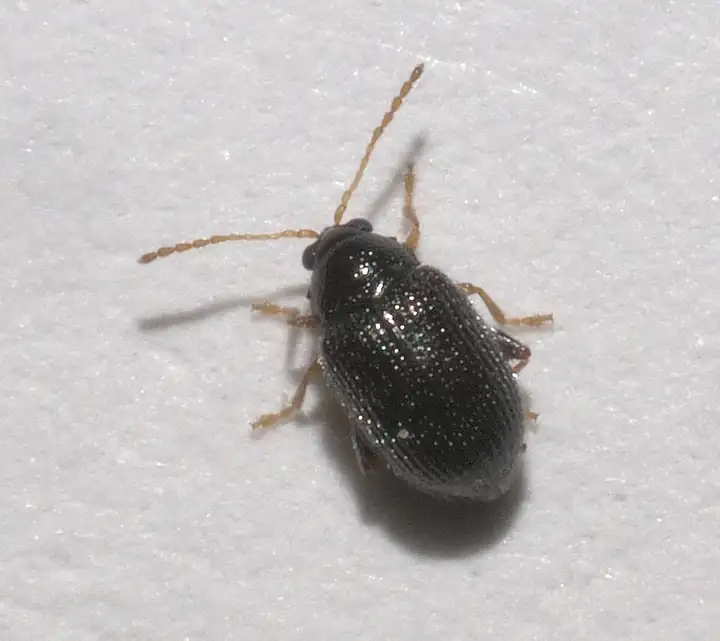
Flea beetles
Several species, such as the crucifer flea beetle (Phyllotreta cruciferae), western black flea beetle (Phyllotreta pusilla), potato flea beetle (Epitrix cucumeris) and palestriped flea beetle (Systena blanda)
| Type | Insect |
|---|---|
| Pressure by region | Moderate: Northeast, Southeast, South Central, Midwest, Great Plains, Mountain West, Southwest, Pacific Northwest, California, Hawaii |
About
Tiny black, bronze or metallic gray beetles, a sixteenth to an eighth of an inch long, with big hind legs that let them jump like fleas. Most species stick to one plant family, but the palestriped flea beetle feeds on many crops.
Spotting it
Damage
Leaves are riddled with shallow pits and small round holes under an eighth of an inch across, like buckshot. Seedlings can be killed; larger plants usually shrug it off.
How to find it early
Check seedlings often for small beetles that jump when you touch the leaf, and for fresh shot-holes. Yellow sticky cards also catch them.
When
Spring and early summer; plants are usually past the danger stage by the four- to five-leaf stage in midsummer.
Life cycle
Adults overwinter in plant debris and become active in spring, laying eggs in the soil or plant tissue. There are usually one to two generations a year in Minnesota and two to three in Colorado.
What to do, gentlest first
Start at the top. Sprays are a last step; always read and follow the product label.
Give plants a fast start Prevent
Use transplants or sow thickly so plants outgrow the damage. Time plantings to avoid peak beetle activity and clear debris and weeds where adults overwinter.
Radish trap crop Prevent
Plant radish or daikon 7 to 14 days before the main crop to draw beetles away, then deal with the beetles on the trap plants.
Sticky cards or a vacuum By hand
Yellow sticky traps, a sweep net or a handheld vacuum can remove adults.
Beetles reinvade quickly, so repeat often.
Floating row cover Barrier
Cover seedlings right away and keep them covered through establishment, sealing the edges.
Spinosad, pyrethrins or kaolin clay Organic spray
These are labeled for flea beetles. Longer-lasting products work better because beetles keep flying in.
Colorado State says diatomaceous earth and kaolin mainly repel. Spinosad and pyrethrins are toxic to bees while wet, so spray in the evening and keep them off flowering crops such as squash, eggplant and potatoes. Follow the label and pre-harvest interval.
Permethrin Conventional spray
Colorado State lists permethrin for most vegetable crops. Use it only for seedlings under heavy attack.
Highly toxic to bees and beneficial insects (PNW 591); do not spray plants in bloom. Check that your crop is on the label and follow the pre-harvest interval.
Garden friends that go after it
Big-eyed bugs, Spined soldier bug
Protect these helpers: skip broad sprays when they're around.
Plants it goes after
Amaranth (greens), Anemone (windflower), Arugula, Beet, Bok choy, Broccoli, Broccoli raab (rapini), Brussels sprouts, Cabbage, Cauliflower, Celeriac, Cleome (spider flower), Cuphea (cigar plant and kin), Eggplant, Epazote, Gaura (whirling butterflies), Green beans (snap beans), Hardy hibiscus (rose mallow), Horseradish, Kale, Kohlrabi, Komatsuna, Lettuce, Mâche (corn salad), Marsh mallow, Mizuna, Mustard greens, Napa cabbage, Ornamental kale and cabbage, Ornamental sweet potato vine, Penstemon (beardtongue), Pepper (sweet and chili), Petunia, Potato, Radish, Rutabaga, Spinach, Sweet corn, Swiss chard, Tatsoi, Tomatillo, Tomato, Turnip, Zucchini and summer squash
Pressure by region
Colorado State notes the western black flea beetle is the most damaging species there, peaking on cabbage-family crops in June. Hawaii lists the tobacco flea beetle as a home-garden pest (CTAHR). A UAF Master Gardener post reports flea beetles riddling pak choi and arugula in an Alaska garden, but no source says how common they are there, so Alaska's low rating is an estimate.
| Northeast | Moderate |
|---|---|
| Southeast | Moderate |
| South Central | Moderate |
| Midwest | Moderate |
| Great Plains | Moderate |
| Mountain West | Moderate |
| Southwest | Moderate |
| Pacific Northwest | Moderate |
| California | Moderate |
| Alaska | Low |
| Hawaii | Moderate |
Ratings come from extension sources where available; some are estimates, as noted above.
Sources
- extension.umn.edu
- extension.colostate.edu
- www3.ctahr.hawaii.edu
- s3.wp.wsu.edu
- alaskamastergardener.community.uaf.edu
Photo: Photo: Robert Webster, CC BY-SA 4.0, via Wikimedia Commons (CC BY-SA 4.0). Photo resized for the web.

Planting dates and advice are general guidance; check with your local Cooperative Extension office for your area.