
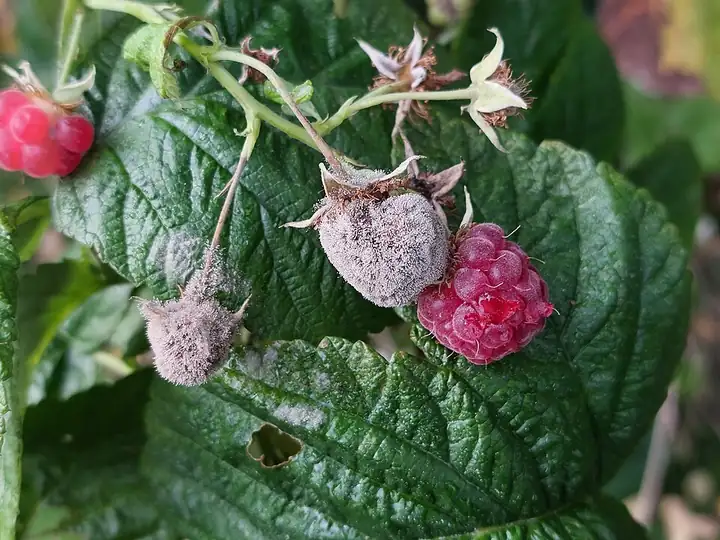
Gray mold (Botrytis)
Fungus (Botrytis cinerea)
| Type | Fungus |
|---|---|
| Cause | Fungus (Botrytis cinerea) |
| When | Cool, wet spells: bloom time for strawberries, and any rainy stretch at harvest. |
About
Gray mold rots soft fruit, fading flowers and tender stems of hundreds of plants, from strawberries and raspberries to tomatoes, beans and garden flowers. It loves cool, damp weather and dying plant tissue.
Also called gray mold, gray mold (Botrytis blight), gray mold (Botrytis fruit rot), Botrytis gray mold, Botrytis bunch rot, Botrytis blight, Botrytis fruit rot
How to recognize it
Symptoms
Brown, water-soaked spots appear on fruit, blossoms or stems and soon grow a fuzzy gray coat of spores. On strawberries rot usually starts at the stem end or where a berry touches soil or another rotten berry, and infected blossoms can blight.
Often confused with
White mold also rots stems in cool, wet weather, but its growth is white and cottony with hard black sclerotia rather than gray fuzz.
Worse when
Cool, damp weather (Botrytis is most active around 65 to 75°F), high humidity, crowded plants and aging or injured tissue.
How it spreads
Spores move by wind and splashing water, and the fungus lives on dead flowers, leaves, overripe fruit and plant debris.
When
Cool, wet spells: bloom time for strawberries, and any rainy stretch at harvest.
What to do, gentlest first
Prevention works best; most sprays only protect healthy leaves and can't cure infected ones. Always read and follow the product label.
Space plants and keep fruit off the soil Prevent
Space plants for airflow, use raised beds, and mulch strawberries so fruit does not touch soil.
Water at the base Prevent
Use drip or soaker hoses; if you must sprinkle, water in the morning so plants dry quickly.
Pick often and remove moldy parts By hand
Harvest ripe fruit promptly, remove moldy fruit and spent flowers, and clear plant debris.
Copper or neem oil Organic spray
Clemson lists copper and neem oil among home-garden options for gray mold, noting neem is a weaker choice.
These only protect healthy tissue and must go on before rot starts. Never spray oil within 2 weeks of a sulfur spray, above 90°F, or on drought-stressed plants (UC IPM). Neem and other oils can harm bees and other insects they hit, so spray in the evening when bees are not on the plants, and follow the label.
Chlorothalonil, captan or thiophanate-methyl Conventional spray
Clemson lists these for homeowner use on labeled plants. They protect; they do not cure fruit that is already rotting.
Chlorothalonil is a protectant: it keeps new infections from starting but does not cure existing spots. UC IPM rates it highly hazardous to fish and other aquatic life, and product labels carry a DANGER signal word. Keep it out of water and off flowering plants (Clemson advises spraying in the late evening to spare pollinators), wear gloves and eye protection, and follow the label and pre-harvest interval.
Plants it affects
African violet, Apple (backyard tree), Baby's breath, Begonia, Black raspberry (blackcap), Blackberry, Blueberry, Calendula (pot marigold), California poppy, Cardoon, Chickpea, Chrysanthemum (garden mum), Cornelian cherry, Cosmos, Crown of thorns, Dahlia, Delphinium, Endive and escarole, Flowering tobacco (nicotiana), Geranium (annual, Pelargonium), Gerbera daisy, Gladiolus, Gomphrena (globe amaranth), Grape, Green beans (snap beans), Hardy kiwi (kiwiberry), Hellebore (Lenten rose), Kousa dogwood, Lentil, Lettuce, Lily (Lilium), Marigold, Moth orchid, Pansy and viola, Peach, Pear, Peony, Petunia, Plum, Poppy (Oriental, Iceland, corn and breadseed poppies), Prayer plants (calathea, maranta), Primrose, Ranunculus, Raspberry, Rose (garden and landscape roses), Salvia (ornamental sage), Sea lavender, Shallot, Snapdragon, Stock, Strawberry, Tomato, Torenia (wishbone flower), Tulip, Verbena (garden verbena), Vinca (annual vinca, Madagascar periwinkle)
Sources
Photo: Photo: Josef Schlaghecken, CC BY 4.0, via Wikimedia Commons (CC BY 4.0). Photo resized for the web.

Planting dates and advice are general guidance; check with your local Cooperative Extension office for your area.