
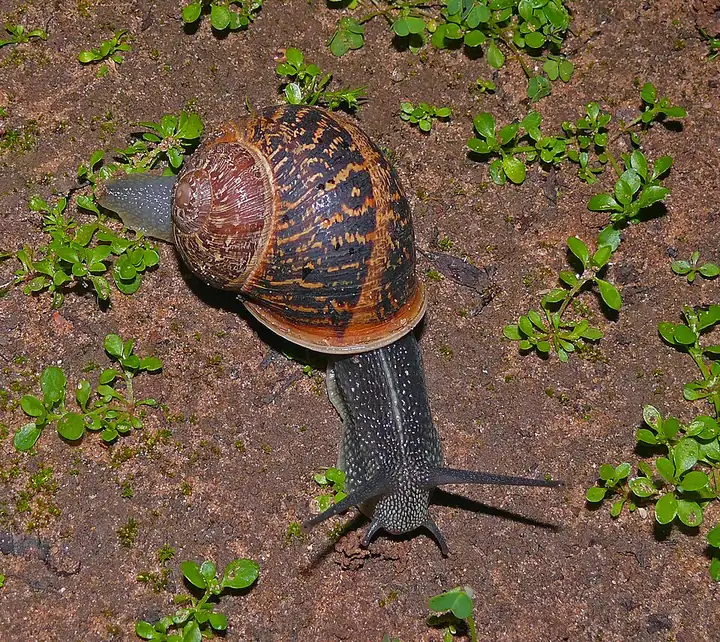
Brown garden snail
Cornu aspersum (formerly Helix aspersa)
| Type | Slug or snail |
|---|---|
| When | Rainy and cool seasons; year-round in mild-winter areas. |
| Pressure by region | High pressure: California, Hawaii |
About
The familiar brown-and-tan spiral-shelled snail, brought to California from France in the 1850s. In hot or cold weather it seals itself into its shell and waits.
Spotting it
Damage
Like slugs, snails chew irregular, smooth-edged holes in leaves, flowers and fruit and leave silvery slime trails. Seedlings and tender growth suffer most.
How to find it early
Follow dried silvery trails on paths and pots in the morning back to hiding spots under pot rims, boards and dense ground cover, or search by flashlight after dark.
When
Rainy and cool seasons; year-round in mild-winter areas.
Life cycle
Each clutch holds 30 to 120 eggs buried in moist soil, hatching in about two weeks in summer, and snails take about two years to mature in southern California. Snails are active year-round where winters are mild.
What to do, gentlest first
Start at the top. Sprays are a last step; always read and follow the product label.
Remove hiding places and switch to drip Prevent
Clear boards, stones, debris and dense ground covers, water at sunrise with drip, and favor plants snails avoid such as lavender, rosemary, sage and nasturtium.
Hand-pick and trap By hand
Pick snails at night with gloves, and set 12-by-15-inch boards raised an inch off the ground to collect them.
In Hawaii use gloves or tongs because of rat lungworm.
Copper bands Barrier
A copper band 4 to 6 inches wide, buried an inch deep, around raised beds keeps snails out.
Diatomaceous earth fails once damp; eggshells and coffee grounds have not been shown to work.
Decollate snails (southern California only) Natural enemies
This predatory snail eats brown garden snails.
It may legally be released only in certain southern and central California counties, never near natural areas, and baits will kill it too.
Iron phosphate bait Organic spray
Scatter thinly in the evening near walls and damp spots, not on plants.
Safer around dogs, children and wildlife (UC IPM), but still follow the label and keep pets from eating it. It also kills native snails.
Metaldehyde bait (avoid where pets or children could reach it) Conventional spray
Fast-acting, but safer baits exist.
Metaldehyde is very poisonous to dogs and cats, and the pellets attract dogs; signs can start within minutes to three hours after a dog eats it (NPIC). UC IPM says not to use it where children or pets could encounter it. Use iron phosphate instead; if you do use it, read and follow the label, store bait out of reach, and call a vet at once if a pet eats it.
Garden friends that go after it
Fireflies (lightning bugs), Ground beetles
Protect these helpers: skip broad sprays when they're around.
Plants it goes after
Agave (century plant), Amaryllis, Baby's breath, Begonia, Bird's nest fern, Black-eyed Susan, Broccoli raab (rapini), Brunnera (Siberian bugloss), Caladium (angel wings), Canna, Cardinal flower, Cardoon, Celosia, Clivia (bush lily), Daffodil, Daylily, Delphinium, Dianthus (pinks, sweet William, carnation), Great blue lobelia, Hellebore (Lenten rose), Hepatica, Hosta (plantain lily), Impatiens, Iris, Larkspur (annual larkspur), Lily (Lilium), Liriope (lilyturf, monkey grass), Lupine (and Texas bluebonnet), Mâche (corn salad), Malabar spinach, Mandarin (satsuma, clementine, tangerine), Mexican mint marigold (Texas tarragon), Mexican sunflower (tithonia), Mizuna, Napa cabbage, Orange and blood orange, Pansy and viola, Passion fruit, Perilla (shiso), Petunia, Poppy (Oriental, Iceland, corn and breadseed poppies), Primrose, Radicchio, Salsify (oyster plant), Sedum (stonecrop), Solomon's seal, Spiderwort, Statice (annual statice), Strawberry, Strawflower, Sweet pea, Swiss chard, Tomato, Trillium, Tulip, Twinleaf, Verbena (garden verbena), Virginia bluebells, Watercress, White sapote, Wild ginger
Pressure by region
The brown garden snail is a serious pest mainly in California. UF/IFAS says it also lives along the West Coast to British Columbia and in most southeastern states north to New Jersey without the same pest status, and it is not established in Florida. Hawaii has other pest snails and semi-slugs that can carry rat lungworm (CTAHR). No Alaska source was found, so Alaska's low rating is an estimate.
| Northeast | Low |
|---|---|
| Southeast | Low |
| South Central | Low |
| Midwest | Low |
| Great Plains | Low |
| Mountain West | Low |
| Southwest | Low |
| Pacific Northwest | Moderate |
| California | High pressure |
| Alaska | Low |
| Hawaii | High pressure |
Ratings come from extension sources where available; some are estimates, as noted above.
Sources
Photo: Photo: Zachi Evenor, CC BY 2.0, via Wikimedia Commons (CC BY 2.0). Photo resized for the web.

Planting dates and advice are general guidance; check with your local Cooperative Extension office for your area.