
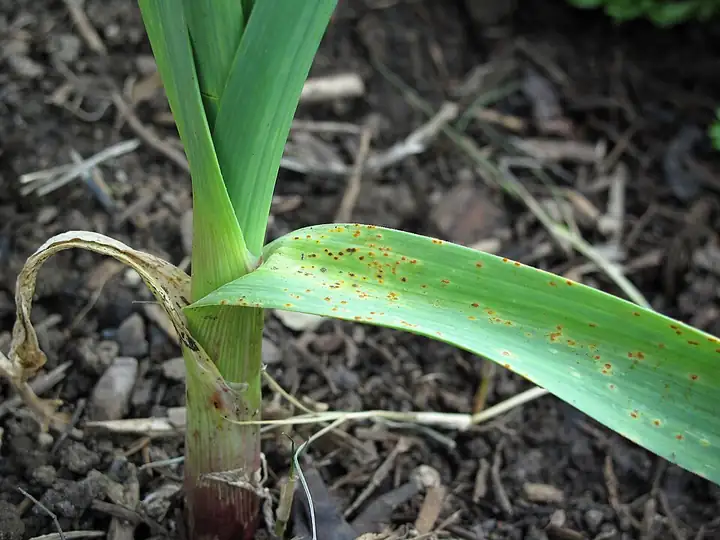
Rust
Fungi (host-specific rusts such as Uromyces appendiculatus on beans, Puccinia asparagi on asparagus and Puccinia sorghi on corn)
| Type | Fungus |
|---|---|
| Cause | Fungi (host-specific rusts such as Uromyces appendiculatus on beans, Puccinia asparagi on asparagus and Puccinia sorghi on corn) |
About
Rusts are fungi that make powdery orange, red-brown or black pustules on leaves and stems; the rusts on beans, asparagus and corn are different species. On beans, asparagus and sweet corn they weaken plants and cut yields in wet, dewy weather.
Also called rust, leaf rust, asparagus rust, bean rust, common rust
How to recognize it
Symptoms
Small raised pustules break open to release powdery orange to red-brown spores, often with a yellow halo on bean leaves. Late in the season black pustules may form. Badly infected leaves yellow, dry and drop; asparagus ferns turn rusty and die back early.
Often confused with
White rust makes white blisters rather than colored powder; bacterial spots do not release powder when rubbed.
Worse when
Warm days, cool nights with heavy dew, and long periods of wet leaves; corn rust likes 60 to 75°F with high humidity.
How it spreads
Spores blow on the wind; bean and asparagus rust survive winter as black spores on crop debris and volunteers, while corn rust cannot overwinter in the North and blows in from the South each year.
When
Summer, especially in stretches of heavy dew; asparagus rust runs through summer on the ferns.
What to do, gentlest first
Prevention works best; most sprays only protect healthy leaves and can't cure infected ones. Always read and follow the product label.
Resistant varieties Prevent
Plant rust-resistant bean varieties, tolerant asparagus such as 'Jersey Centennial', and rust-resistant sweet corn varieties (UMass lists several).
Bean rust has many races, so resistance may not hold everywhere.
Clean up and remove volunteers Prevent
Remove bean debris and volunteers after harvest, clear old asparagus ferns before spears emerge, destroy wild asparagus nearby, and disinfect bean poles.
Airflow and dry leaves Prevent
Space plants, run rows with the prevailing wind, water so leaves dry quickly, avoid excess nitrogen and keep potassium adequate.
Pick off early infected leaves By hand
Removing the first rusty leaves can slow spread in a small planting.
Sulfur, as a preventive Organic spray
Sulfur keeps fungal spores from germinating, so it must go on before rust is widespread. Check that the product is labeled for rust on your crop.
Sulfur works only as a preventive. Do not use it in hot weather (Purdue says above 80°F, UC IPM above 90°F) or within 2 weeks (UC IPM) to a month (Purdue) of an oil spray, or leaves can be burned. It can injure cucurbits (some squash and melon varieties are sulfur-sensitive), currants, gooseberries, apricots and raspberries. UC IPM's pesticide database says not to apply sulfur to, or let it drift onto, flowering plants (including weeds). Follow the label.
Labeled rust fungicides Conventional spray
UMass notes fungicides help only if the first sprays go on before rust is widespread. Use a product labeled for your crop.
Follow the label, including which crops it may be used on and how many days to wait before harvest.
Plants it affects
Amsonia (bluestar), Anemone (windflower), Anise hyssop, Apothecary rose, Asparagus, Aster, Bachelor's button (cornflower), Bee balm, Black gum (tupelo), Black-eyed Susan, Blazing star (liatris), Blue grama, Buffaloberry (silver buffaloberry), Canna, Chrysanthemum (garden mum), Cleome (spider flower), Clivia (bush lily), Coral bells (heuchera), Currant, Dianthus (pinks, sweet William, carnation), Dry beans (pinto, black, kidney, navy), Dusty miller, Eastern hemlock, Edamame, Elderberry (American), Feather reed grass, Fig, Forget-me-not, Gaura (whirling butterflies), Geranium (annual, Pelargonium), Gladiolus, Goldenrod, Gooseberry, Green beans (snap beans), Hardy hibiscus (rose mallow), Hydrangea, Hydrangea tree (panicle hydrangea), Ironweed, Jaboticaba, Jerusalem artichoke (sunchoke), Joe-Pye weed, Leek, Lima beans, Maiden grass (Miscanthus), Marsh mallow, Mayapple, Mexican mint marigold (Texas tarragon), Milkweed, Mint, Mock orange, Mountain mint, Ornamental onion (allium), Peanut, Penstemon (beardtongue), Plum, Primrose, Rhododendron, Rose (garden and landscape roses), Salvia (ornamental sage), Sedges (Carex), Smokebush, Snapdragon, Sumac, Sunflower, Sweet corn, Switchgrass, Tepary bean, Thornless honeylocust, Trillium, Wild geranium (spotted cranesbill)
Sources
Photo: Photo: Downtowngal, Public domain, via Wikimedia Commons. Photo resized for the web.

Planting dates and advice are general guidance; check with your local Cooperative Extension office for your area.