
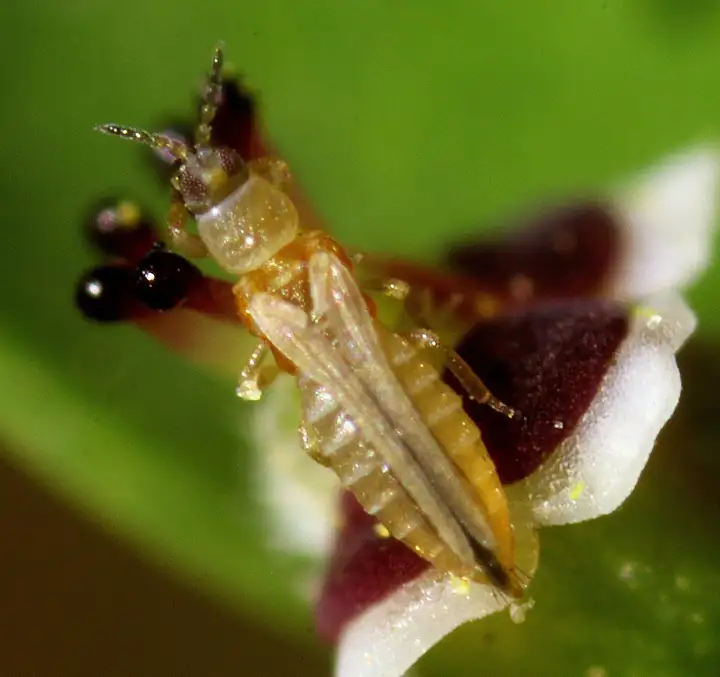
Thrips
Onion thrips (Thrips tabaci) and western flower thrips (Frankliniella occidentalis), among others
| Type | Insect |
|---|---|
| When | Late spring through summer, worst in warm weather. |
| Pressure by region | Moderate: Northeast, Southeast, South Central, Midwest, Great Plains, Mountain West, Southwest, Pacific Northwest, California, Hawaii |
About
Slender insects less than a twentieth of an inch long with fringed wings. They rasp plant cells and suck out the contents.
Spotting it
Damage
Leaves and fruit get silvery or brown patches, stippling and tiny black specks of droppings, and shoot tips can be distorted. Western flower thrips spread tomato spotted wilt virus.
How to find it early
Shake foliage over white paper and look for tiny moving slivers, and hang yellow sticky cards. On onions, look for silvery streaks on the leaves.
When
Late spring through summer, worst in warm weather.
Life cycle
Females lay eggs in leaves and buds; after two feeding larval stages, most species drop to the soil or leaf litter to pupate. Egg to adult can take about two weeks in warm weather, with up to about eight generations a year.
What to do, gentlest first
Start at the top. Sprays are a last step; always read and follow the product label.
Weeds, water and fertilizer Prevent
Remove weeds that host thrips, water properly, and avoid excess nitrogen. Prune off infested shoot tips.
Reflective mulch and fine row cover Barrier
Silver or gray reflective mulch under young plants repels thrips, and fine-mesh row cover keeps them off seedlings.
Conserve predators Natural enemies
Predatory mites, minute pirate bugs, lacewings and parasitic wasps attack thrips; avoid persistent pesticides that kill them.
Spinosad, oil, soap, neem or pyrethrins Organic spray
Spinosad is the most effective of these; oils, soaps, neem and pyrethrins need thorough coverage.
Spinosad is toxic to bees and some natural enemies when sprayed and for about a day afterward, so do not apply it to plants in flower (UC IPM). Pyrethrins are also highly toxic to bees. Follow the label and pre-harvest interval.
Skip broad-spectrum insecticides Conventional spray
UC IPM advises avoiding organophosphates, carbamates, pyrethroids and acephate for thrips.
They are highly toxic to natural enemies and pollinators and can set off spider mite outbreaks (UC IPM). If you use any insecticide, follow the label.
Garden friends that go after it
Big-eyed bugs, Brown lacewings, Crab spiders (flower spiders), Damsel bugs, Green lacewings, Jumping spiders, Minute pirate bugs, Predatory mites, Snakeflies, Syrphid flies (hover flies, flower flies)
Protect these helpers: skip broad sprays when they're around.
Plants it goes after
African violet, Amaryllis, Arrowhead vine (syngonium), Avocado, Azalea, Begonia, Blanket flower (gaillardia), Calibrachoa (million bells), California poppy, Calla lily, Cape plumbago, Celeriac, Celosia, Chives, Chrysanthemum (garden mum), Croton, Crown of thorns, Cuphea (cigar plant and kin), Cyclamen (florist's), Cymbidium orchid, Dahlia, Daylily, Dendrobium orchid, Dracaena (corn plant, dragon tree), Dragon fruit (pitaya), Fennel, Fiddle-leaf fig, Flowering tobacco (nicotiana), Gardenia (cape jasmine), Garlic, Gerbera daisy, Gladiolus, Goji (wolfberry), Guava, Hardy kiwi (kiwiberry), Heartleaf philodendron, Highbush cranberry (American cranberrybush), Hollyhock, Impatiens, Leek, Lilac, Lucky bamboo, Luffa (loofah gourd), Mandarin (satsuma, clementine, tangerine), Mandevilla, Mango, Marigold, Mexican sunflower (tithonia), Monstera (Swiss cheese plant), Moth orchid, Natal plum (carissa), Olive, Onion, Orange and blood orange, Ornamental onion (allium), Ornamental sweet potato vine, Pansy and viola, Parlor palm, Passion fruit, Peanut, Pepper (sweet and chili), Petunia, Pineapple guava (feijoa), Pomegranate, Pothos, Ranunculus, Red hot poker (torch lily), Rose (garden and landscape roses), Rubber plant, Salvia (ornamental sage), Shallot, Snake plant, Southern peas, Starfruit (carambola), Switchgrass, Tamarind, Tomato, Tropical hibiscus, Tropical pitcher plant (nepenthes), Tuberose, Umbrella plant (schefflera), Verbena (garden verbena), Viburnum, Vinca (annual vinca, Madagascar periwinkle), ZZ plant
Pressure by region
Hawaii lists melon, western flower and red-banded thrips among home-garden pests (CTAHR). No Alaska source was found, so Alaska's low rating is an estimate.
| Northeast | Moderate |
|---|---|
| Southeast | Moderate |
| South Central | Moderate |
| Midwest | Moderate |
| Great Plains | Moderate |
| Mountain West | Moderate |
| Southwest | Moderate |
| Pacific Northwest | Moderate |
| California | Moderate |
| Alaska | Low |
| Hawaii | Moderate |
Ratings come from extension sources where available; some are estimates, as noted above.
Sources
Photo: Photo: Dave Kirkeby, CC BY-SA 4.0, via Wikimedia Commons (CC BY-SA 4.0). Photo resized for the web.

Planting dates and advice are general guidance; check with your local Cooperative Extension office for your area.