
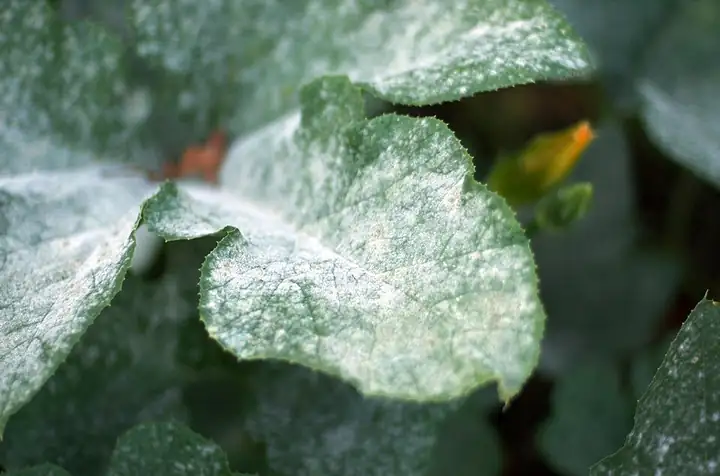
Powdery mildew
Fungi (many host-specific species, most commonly in the genera Erysiphe and Sphaerotheca)
| Type | Fungus |
|---|---|
| Cause | Fungi (many host-specific species, most commonly in the genera Erysiphe and Sphaerotheca) |
About
Powdery mildew coats leaves in white, flour-like growth and is one of the most common garden diseases, especially on squash, pumpkins, cucumbers, melons and peas. Each mildew species attacks only certain plants, so mildew on your zinnias will not jump to your squash.
Also called powdery mildew, powdery mildew (rare)
How to recognize it
Symptoms
White to gray powdery patches appear on leaves (mostly the upper surface) and stems, then spread until leaves look dusted with flour. Badly infected leaves yellow, brown and die early, and plants lose vigor; tiny black specks may form in the patches late in the season.
Often confused with
Downy mildew makes yellow spots on top of the leaf with gray to purplish fuzz underneath, while powdery mildew sits on the surface like a dusting of flour.
Worse when
Moderate temperatures (60 to 80°F), shade, crowding and high humidity; unlike most leaf diseases it does not need wet leaves, and heat above 90°F and direct sun slow it.
How it spreads
Windblown spores start new infections every few days to two weeks, and the fungi overwinter on plant debris and living plants.
When
Most of the growing season whenever temperatures sit between 60 and 80°F; it often builds late in the season.
What to do, gentlest first
Prevention works best; most sprays only protect healthy leaves and can't cure infected ones. Always read and follow the product label.
Resistant varieties Prevent
Mildew-resistant varieties are sold for cucumber, cantaloupe and other melons, peas, pumpkins and squash (UC IPM).
Resistant plants can still get some mildew.
Sun, space and moderate feeding Prevent
Plant in full sun, space for airflow, avoid too much nitrogen fertilizer, and do not overwater.
Remove infected leaves and clean up By hand
Pick off the worst leaves early and remove or hot-compost infected plants at season's end.
Bacillus subtilis products Natural enemies
UC IPM lists this biological fungicide as a preventive for powdery mildew, though it has not proven as effective as oils or sulfur.
It prevents new infections and must go on before mildew takes hold. UC IPM's pesticide database says not to apply it to, or let it drift onto, flowering plants. Follow the label.
Sulfur Organic spray
Wettable sulfur is an effective preventive, UC IPM says, if applied before or right when mildew first appears.
Sulfur works only as a preventive. Do not use it in hot weather (Purdue says above 80°F, UC IPM above 90°F) or within 2 weeks (UC IPM) to a month (Purdue) of an oil spray, or leaves can be burned. It can injure cucurbits (some squash and melon varieties are sulfur-sensitive), currants, gooseberries, apricots and raspberries. UC IPM's pesticide database says not to apply sulfur to, or let it drift onto, flowering plants (including weeds). Follow the label.
Potassium bicarbonate Organic spray
Kills mildew on contact and leaves some protective residue (UC IPM). Purdue prefers potassium bicarbonate to baking soda, because baking soda's sodium can build up and harm plants.
Test on a few leaves first. Wear gloves and eye protection and follow the label.
Horticultural oil or neem oil Organic spray
UC IPM notes these oils can knock back mildew already present, not just prevent it.
Never spray oil within 2 weeks of a sulfur spray, above 90°F, or on drought-stressed plants (UC IPM). Neem and other oils can harm bees and other insects they hit, so spray in the evening when bees are not on the plants, and follow the label.
Labeled fungicides such as chlorothalonil or myclobutanil Conventional spray
Wisconsin lists chlorothalonil, myclobutanil and others for vegetables. Rotate between chemical groups so the mildew does not become resistant, and choose products labeled for edible crops.
Chlorothalonil is a protectant: it keeps new infections from starting but does not cure existing spots. UC IPM rates it highly hazardous to fish and other aquatic life, and product labels carry a DANGER signal word. Keep it out of water and off flowering plants, wear gloves and eye protection, and follow the label and pre-harvest interval.
Plants it affects
Anise hyssop, Apple (backyard tree), Apricot, Artichoke, Bee balm, Beet, Black-eyed Susan, Blueberry, Borage, Calendula (pot marigold), Cantaloupe (muskmelon), Cardoon, Carrot, Celeriac, Celery, Chamomile (German), Cherry (sweet and tart), Chilacayote, Chrysanthemum (garden mum), Cosmos, Cucamelon, Cucumber, Currant, Dahlia, Dill, Edamame, Eggplant, Elderberry (American), Endive and escarole, English ivy (houseplant), Gooseberry, Grape, Green beans (snap beans), Haskap (honeyberry), Hazelnut (filbert), Highbush cranberry (American cranberrybush), Hops, Jerusalem artichoke (sunchoke), Kalanchoe, Larkspur (annual larkspur), Lettuce, Luffa (loofah gourd), Mango, Marigold, Mock orange, Money tree, Pansy and viola, Papaya, Parsnip, Pear, Peas, Pepper (sweet and chili), Persimmon (American and Asian), Plum, Polka dot plant, Poppy (Oriental, Iceland, corn and breadseed poppies), Purple coneflower (echinacea), Radish, Red twig dogwood, Salsify (oyster plant), Scabiosa (pincushion flower), Scarlet runner bean, Shrubby cinquefoil (potentilla), Southern peas, Sunflower, Sweet pea, Tomatillo, Tomato, Turnip, Watermelon, Winter squash and pumpkin, Yarrow, Zinnia, Zucchini and summer squash
Sources
- ipm.ucanr.edu
- hort.extension.wisc.edu
- extension.psu.edu
- extension.purdue.edu
- ipm.ucanr.edu
- ipm.ucanr.edu
- ipm.ucanr.edu
- hgic.clemson.edu
- ipm.ucanr.edu
Photo: Photo: Jeff Kubina, Public domain, via Wikimedia Commons. Photo resized for the web.

Planting dates and advice are general guidance; check with your local Cooperative Extension office for your area.