
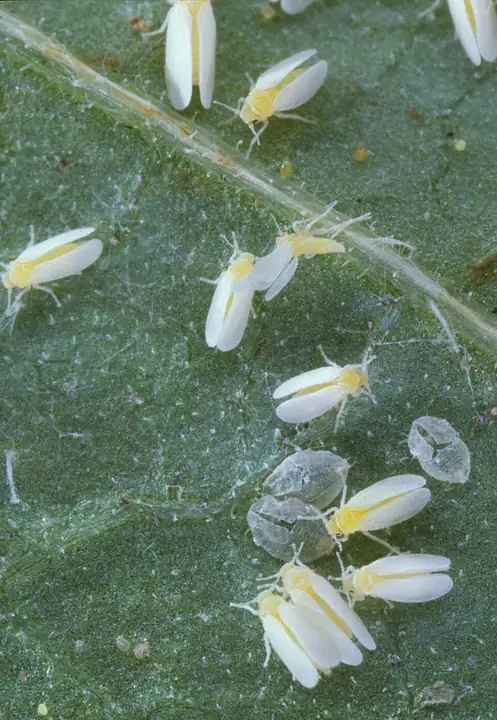
Whiteflies
Greenhouse whitefly (Trialeurodes vaporariorum) and silverleaf or sweetpotato whitefly (Bemisia tabaci), among others
| Type | Insect |
|---|---|
| When | Midsummer to frost in cold-winter areas; year-round in the warmest regions. |
| Pressure by region | High pressure: Southwest, California |
About
Tiny white, moth-like sap-sucking insects that fly up in a cloud when you brush a plant. They breed year-round in warm climates and ride into colder gardens on greenhouse-grown transplants.
Spotting it
Damage
Leaves become stippled, then yellow, dry and drop early, and get sticky with honeydew and black sooty mold. Silverleaf whitefly causes silvery squash leaves and uneven ripening in tomatoes, and some species spread viruses.
How to find it early
Inspect transplants before buying by brushing the leaves. In the garden, check leaf undersides for flat, scale-like nymphs and hang yellow sticky cards.
When
Midsummer to frost in cold-winter areas; year-round in the warmest regions.
Life cycle
Eggs on leaf undersides hatch into crawlers that settle within hours, then pass through four immobile nymph stages before becoming adults. Greenhouse whitefly cannot survive Colorado winters outdoors, while in warm areas whiteflies breed all year.
What to do, gentlest first
Start at the top. Sprays are a last step; always read and follow the product label.
Start clean Prevent
Inspect transplants before buying, remove weeds and infested leaves, and avoid planting favorite hosts back to back.
Water spray, vacuum and sticky cards By hand
Hose adults off, suck them up with a handheld vacuum, and hang yellow sticky traps.
Reflective mulch Barrier
Silver reflective mulch repels whiteflies from young plants.
Protect natural enemies Natural enemies
Lacewings, lady beetles and parasitic wasps give important control when not sprayed; Encarsia formosa wasps can be released in greenhouses.
Insecticidal soap, horticultural oil or neem Organic spray
Spray leaf undersides thoroughly and repeat.
Do not use soaps or oils on stressed plants or above 90°F. They reduce but do not wipe out whiteflies (UC IPM). Oil sprays can stun or kill bees they hit, so spray in the evening when bees are not on the plants, and follow the label.
Avoid broad-spectrum products Conventional spray
UC IPM advises against pyrethroids and imidacloprid for whiteflies.
Whiteflies quickly become resistant, and these products kill the natural enemies; imidacloprid also harms bees and other pollinators. If you use any insecticide, follow the label.
Garden friends that go after it
Big-eyed bugs, Brown lacewings, Green lacewings, Minute pirate bugs, Predatory mites, Snakeflies
Protect these helpers: skip broad sprays when they're around.
Plants it goes after
Ageratum (floss flower), Areca palm, Asparagus fern, Astilbe (false spirea), Azalea, Barbados cherry (acerola), Bird of paradise, Black-eyed Susan vine, Blueberry, Broccoli, Broccoli raab (rapini), Cabbage, Calamondin, Calendula (pot marigold), Cantaloupe (muskmelon), Chayote, Chilacayote, Cleome (spider flower), Coleus, Cucumber, Cuphea (cigar plant and kin), Dieffenbachia (dumb cane), Dry beans (pinto, black, kidney, navy), Eggplant, Endive and escarole, English ivy (houseplant), Finger lime, Flowering tobacco (nicotiana), Fuchsia, Gardenia (cape jasmine), Gaura (whirling butterflies), Geranium (annual, Pelargonium), Gerbera daisy, Green beans (snap beans), Guava, Hardy hibiscus (rose mallow), Holly, Inch plant (wandering dude), Jaboticaba, Kale, Kumquat, Lantana (garden), Lemon, Lemon verbena, Lettuce, Lime (key and Persian), Makrut lime, Mandarin (satsuma, clementine, tangerine), Mandevilla, Mayhaw, Meyer lemon, Mountain laurel, Mulberry (red and black), Napa cabbage, Nasturtium, Natal plum (carissa), Okra, Orange and blood orange, Ornamental sweet potato vine, Papaya, Peperomia, Petunia, Pineapple sage, Poinsettia, Polka dot plant, Pomegranate, Potato, Rhododendron, Rose of Sharon (shrub althea), Salvia (ornamental sage), Sesame, Snapdragon, Statice (annual statice), Strawflower, String of pearls, Swedish ivy, Sweet potato, Tamarind, Tomato, Tropical hibiscus, Verbena (garden verbena), Viburnum, Watercress, Watermelon, Winter squash and pumpkin, Yacon, Zucchini and summer squash, ZZ plant
Pressure by region
In cold-winter zones freezing kills outdoor populations and infestations start from transplants, though Maryland reports whiteflies now overwintering in its warmer central areas. Silverleaf whitefly is a serious outdoor pest in southern California's desert valleys, Arizona, Texas and Florida. Hawaii lists four whitefly species among home-garden pests (CTAHR). No Alaska source was found, so Alaska's low rating is an estimate.
| Northeast | Low |
|---|---|
| Southeast | Moderate |
| South Central | Moderate |
| Midwest | Low |
| Great Plains | Low |
| Mountain West | Low |
| Southwest | High pressure |
| Pacific Northwest | Low |
| California | High pressure |
| Alaska | Low |
| Hawaii | Moderate |
Ratings come from extension sources where available; some are estimates, as noted above.
Sources
Photo: Photo: Scott Bauer, USDA ARS, Public domain (USDA ARS), via Wikimedia Commons. Photo resized for the web.

Planting dates and advice are general guidance; check with your local Cooperative Extension office for your area.