
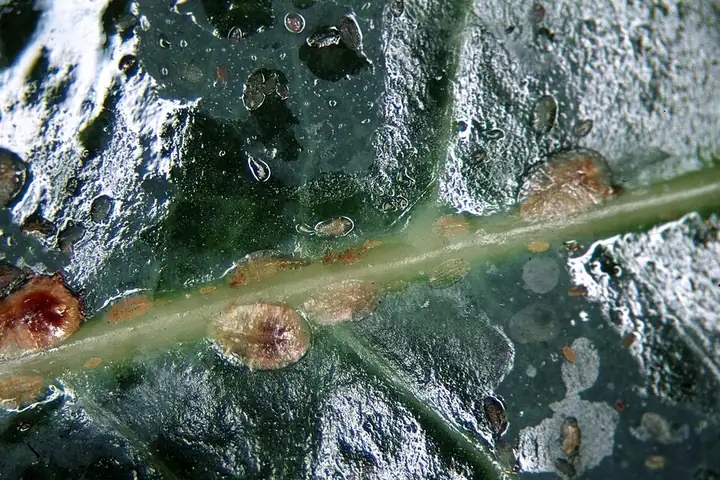
Scale insects
Many species. Armored scales such as San Jose scale (Comstockaspis perniciosa) and white peach scale (Pseudaulacaspis pentagona) live under a hard cover; soft scales are larger and make honeydew.
| Type | Insect |
|---|---|
| When | Present year-round; crawlers appear in spring and summer. |
| Pressure by region | Moderate: Northeast, Southeast, South Central, Midwest, Great Plains, Mountain West, Southwest, Pacific Northwest, California, Hawaii |
About
Scales are sap-sucking insects that look more like bumps than bugs once they settle on bark, twigs, leaves or fruit. Only the tiny yellow-orange young, called crawlers, have working legs and move.
Spotting it
Damage
Heavy infestations yellow leaves, stunt growth and kill twigs, branches and sometimes whole trees. Soft scales drip sticky honeydew that turns black with sooty mold.
How to find it early
Look for crusty bumps on bark, twigs and leaves. To time sprays, wrap a few infested twigs in clear double-sided tape and change it weekly; crawlers show up as yellow or orange specks.
When
Present year-round; crawlers appear in spring and summer.
Life cycle
Most armored scales have several generations a year (San Jose scale has four to six in South Carolina) and spend winter as young nymphs or adult females. Most soft scales have one generation a year.
What to do, gentlest first
Start at the top. Sprays are a last step; always read and follow the product label.
Tolerate light infestations Prevent
Most plants handle low to moderate numbers of scale.
Prune out the worst twigs By hand
Cut out heavily infested twigs and branches when the problem is limited to a few spots.
Protect natural enemies and stop ants Natural enemies
Tiny parasitic wasps and lady beetles control many scales. Ants guard soft scales, so use sticky trunk bands or enclosed ant baits, and avoid broad-spectrum sprays that kill the helpers.
Dormant horticultural oil Organic spray
Spray oil on bark and limbs in winter while the tree is leafless, when temperatures are above 40°F. Clemson suggests a 2 to 3% oil, twice, about 3 weeks and 1 week before buds swell.
Oil can stun or kill bees it hits (PNW 591). Do not spray oil within 2 weeks of a captan fungicide spray (Clemson). Follow the label.
Oil or insecticidal soap at crawler time Organic spray
In spring or summer, spray oil or soap once crawler numbers on your tape have peaked and started to fall. They work only on contact.
Oil can stun or kill bees it hits (PNW 591), so do not spray during bloom or when bees are working. Follow the label and pre-harvest interval.
Crawler sprays; avoid systemics on fruit trees Conventional spray
Clemson lists malathion or permethrin aimed at crawlers for peaches.
Both are highly toxic to bees (PNW 591); do not spray during bloom. UC IPM warns never to apply systemic insecticides such as imidacloprid during or shortly before flowering, and imidacloprid does not control most armored scales anyway. Follow the label and pre-harvest interval.
Garden friends that go after it
Brown lacewings, Green lacewings, Jumping spiders, Lady beetles (ladybugs), Snakeflies
Protect these helpers: skip broad sprays when they're around.
Plants it goes after
Agave (century plant), Air plants (tillandsia), Almond, Aloe vera, Amaryllis, American plum (wild plum), Anthurium (flamingo flower), Apricot, Arborvitae, Areca palm, Aronia (black chokeberry), Avocado, Azalea, Banana (dwarf), Barbados cherry (acerola), Bay laurel, Begonia, Bird of paradise, Bird's nest fern, Black gum (tupelo), Black-eyed Susan vine, Boston fern, Boxwood, Bradford pear (Callery pear), Bromeliads, Buckeye, Calamondin, Camellia, Cape plumbago, Cherry (sweet and tart), Chinese evergreen, Christmas cactus, Clivia (bush lily), Colorado blue spruce, Cornelian cherry, Crape myrtle, Croton, Crown of thorns, Cymbidium orchid, Dendrobium orchid, Dieffenbachia (dumb cane), Dracaena (corn plant, dragon tree), Dragon fruit (pitaya), Eastern hemlock, Eastern redbud, Eastern white pine, English ivy (houseplant), Fiddle-leaf fig, Fig, Finger lime, Fir, Flowering cherry, Flowering dogwood, Gardenia (cape jasmine), Geranium (annual, Pelargonium), Guava, Hackberry, Hardy hibiscus (rose mallow), Hazelnut (filbert), Heartleaf philodendron, Holly, Hop-hornbeam (ironwood), Hoya (wax plant), Hydrangea, Hydrangea tree (panicle hydrangea), Inch plant (wandering dude), Jaboticaba, Jade plant, Japanese barberry, Japanese maple, Juniper, Kalanchoe, Kousa dogwood, Kumquat, Lemon, Lilac, Lime (key and Persian), Linden, Liriope (lilyturf, monkey grass), Loquat, Lucky bamboo, Lychee, Maidenhair fern, Makrut lime, Mamey sapote, Mandarin (satsuma, clementine, tangerine), Mandevilla, Mango, Mayhaw, Meyer lemon, Mock orange, Money tree, Monstera (Swiss cheese plant), Moth orchid, Mountain laurel, Mulberry (red and black), Nandina (heavenly bamboo), Natal plum (carissa), Nerve plant (fittonia), Nopal and prickly pear (Opuntia), Norfolk Island pine, Oaks (white, red and pin oak), Oleander, Olive, Orange and blood orange, Parlor palm, Peace lily, Peach, Pear, Peony, Peperomia, Persimmon (American and Asian), Pilea (Chinese money plant), Pineapple, Pineapple guava (feijoa), Plum, Poinsettia, Pomegranate, Ponytail palm, Pothos, Prayer plants (calathea, maranta), Purple heart, Quince, Red maple, Red twig dogwood, Rhododendron, Rubber plant, Saucer magnolia, Sedum (stonecrop), Serviceberry (juneberry, saskatoon), Snake plant, Southern magnolia, Spider plant, Spirea, Starfruit (carambola), String of hearts, Sugar maple, Sumac, Surinam cherry, Sycamore, Tamarind, Tropical hibiscus, Tropical pitcher plant (nepenthes), Tuberose, Tulip tree, Umbrella plant (schefflera), Viburnum, White sapote, Winterberry, Witch hazel, Yew, Yucca cane, ZZ plant
Pressure by region
There are many scale species across the country. Sourced for California (UC IPM) and South Carolina (Clemson); all other ratings are estimates.
| Northeast | Moderate |
|---|---|
| Southeast | Moderate |
| South Central | Moderate |
| Midwest | Moderate |
| Great Plains | Moderate |
| Mountain West | Moderate |
| Southwest | Moderate |
| Pacific Northwest | Moderate |
| California | Moderate |
| Alaska | Low |
| Hawaii | Moderate |
Ratings come from extension sources where available; some are estimates, as noted above.
Sources
Photo: Photo: Whitney Cranshaw, Colorado State University, Bugwood.org, CC BY 3.0 US, via Wikimedia Commons (CC BY 3.0 US). Photo resized for the web.

Planting dates and advice are general guidance; check with your local Cooperative Extension office for your area.