
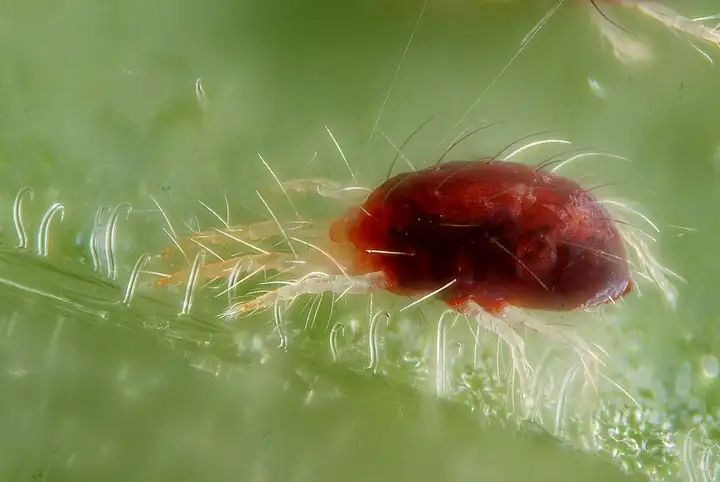
Twospotted spider mite
Tetranychus urticae
| Type | Mite |
|---|---|
| When | Hot, dry stretches of summer; UC IPM says June through September in California. |
| Pressure by region | Moderate: Northeast, Southeast, South Central, Midwest, Great Plains, Mountain West, Southwest, Pacific Northwest, California, Hawaii |
About
Not insects but tiny relatives of spiders, about a fiftieth of an inch long, pale green-yellow with a dark blotch on each side. They thrive in hot, dry weather and can multiply explosively once temperatures pass 90°F.
Spotting it
Damage
Leaves get fine pale stippling that turns them bronze and dusty-looking, and heavy colonies spin webbing over shoot tips.
How to find it early
Hold white paper under a leaf and tap it sharply; moving specks on the paper mean mites, weeks before leaves look dusty.
When
Hot, dry stretches of summer; UC IPM says June through September in California.
Life cycle
A female lays up to 100 eggs, and a generation takes 7 to 20 days, or as few as 5 in high summer, so Pennsylvania sees 10 to 15 generations a year. Mated orange-red females overwinter under bark and litter at the base of plants.
What to do, gentlest first
Start at the top. Sprays are a last step; always read and follow the product label.
Water well and keep dust down Prevent
Keep plants from drought stress and wet down dusty paths, since stressed, dusty plants are where outbreaks start.
Hose off leaf undersides By hand
A strong spray of water on the undersides of leaves knocks mites down.
Predatory mites and other allies Natural enemies
Predatory mites, minute pirate bugs, lacewings and the tiny spider mite destroyer lady beetle keep mites in check when not sprayed.
Insecticidal soap, horticultural oil or sulfur Organic spray
Cover leaf undersides thoroughly and repeat.
Do not use soaps or oils on water-stressed plants or above 90°F, and oil sprays can stun or kill bees they hit, so spray when bees are not on the plants. Do not use sulfur within 30 days of an oil spray or above 90°F, and check before using sulfur on cucurbits. Follow the label.
Miticides, rotated Conventional spray
Use a labeled miticide only for severe outbreaks, rotating products because mites build resistance fast.
Avoid carbaryl, organophosphates and pyrethroids: they kill mite predators and can make outbreaks worse. Follow the label and pre-harvest interval.
Garden friends that go after it
Big-eyed bugs, Brown lacewings, Damsel bugs, Green lacewings, Harvestmen (daddy longlegs), Lady beetles (ladybugs), Minute pirate bugs, Predatory mites, Rove beetles, Snakeflies
Protect these helpers: skip broad sprays when they're around.
Plants it goes after
Ageratum (floss flower), Almond, Amaranth (greens), Amaryllis, Anthurium (flamingo flower), Apricot, Arborvitae, Areca palm, Arrowhead vine (syngonium), Asparagus fern, Aster, Avocado, Azalea, Bald cypress, Banana (dwarf), Begonia, Bird of paradise, Black raspberry (blackcap), Black-eyed Susan, Black-eyed Susan vine, Blackberry, Boston fern, Burning bush, Butterfly bush, Calamondin, Calibrachoa (million bells), Camellia, Cantaloupe (muskmelon), Cape plumbago, Celeriac, Celosia, Chaya (tree spinach), Chayote, Chinese evergreen, Christmas cactus, Chrysanthemum (garden mum), Clematis, Cleome (spider flower), Coleus, Columbine, Creeping phlox (moss phlox), Croton, Crown of thorns, Cucumber, Currant, Cyclamen (florist's), Cymbidium orchid, Dahlia, Daylily, Delphinium, Dendrobium orchid, Dieffenbachia (dumb cane), Dracaena (corn plant, dragon tree), Dragon fruit (pitaya), Eastern hemlock, Eastern white pine, Eggplant, Elderberry (American), Elephant ear, English ivy (houseplant), Feverfew, Fiddle-leaf fig, Fig, Finger lime, Fir, Flowering cherry, Flowering crabapple, Forsythia, Fuchsia, Garden phlox (tall phlox), Geranium (annual, Pelargonium), Gerbera daisy, Gladiolus, Goji (wolfberry), Green beans (snap beans), Hardy kiwi (kiwiberry), Hazelnut (filbert), Heartleaf philodendron, Holly, Hollyhock, Hops, Hoya (wax plant), Hydrangea, Hydrangea tree (panicle hydrangea), Impatiens, Inch plant (wandering dude), Jaboticaba, Jade plant, Jostaberry, Kalanchoe, Kumquat, Lantana (garden), Larkspur (annual larkspur), Lemon, Lemon verbena, Lima beans, Lime (key and Persian), Linden, Loropetalum, Lucky bamboo, Luffa (loofah gourd), Makrut lime, Mamey sapote, Mandarin (satsuma, clementine, tangerine), Mandevilla, Mango, Marigold, Mexican mint marigold (Texas tarragon), Mexican sunflower (tithonia), Meyer lemon, Miracle fruit, Monstera (Swiss cheese plant), Morning glory, Mulberry (red and black), Nanking cherry, Natal plum (carissa), Nerve plant (fittonia), Orange and blood orange, Ornamental sweet potato vine, Pansy and viola, Papaya, Parlor palm, Passion fruit, Peace lily, Pear, Pecan, Pentas (Egyptian star flower), Peperomia, Pilea (Chinese money plant), Pineapple, Plum, Poinsettia, Pomegranate, Ponytail palm, Prayer plants (calathea, maranta), Primrose, Ranunculus, Rhododendron, Rose (garden and landscape roses), Rose of Sharon (shrub althea), Rubber plant, Salvia (ornamental sage), Scabiosa (pincushion flower), Serviceberry (juneberry, saskatoon), Shasta daisy, Shrubby cinquefoil (potentilla), Snake plant, Snapdragon, Southern peas, Statice (annual statice), Stevia, Strawberry, Succulents (echeveria, haworthia, sedum), Sumac, Summersweet (Clethra), Swedish ivy, Switchgrass, Sycamore, Tropical hibiscus, Tuberose, Umbrella plant (schefflera), Venus flytrap, Verbena (garden verbena), Viburnum, Watercress, Watermelon, Winterberry
Pressure by region
More a matter of weather than zone: outbreaks follow hot, dry, dusty conditions and drought-stressed plants anywhere, while damp weather favors a fungus that kills them. Hawaii lists carmine and twospotted spider mites among home-garden pests (CTAHR). No Alaska source was found, so Alaska's low rating is an estimate.
| Northeast | Moderate |
|---|---|
| Southeast | Moderate |
| South Central | Moderate |
| Midwest | Moderate |
| Great Plains | Moderate |
| Mountain West | Moderate |
| Southwest | Moderate |
| Pacific Northwest | Moderate |
| California | Moderate |
| Alaska | Low |
| Hawaii | Moderate |
Ratings come from extension sources where available; some are estimates, as noted above.
Sources
Photo: Photo: Gilles San Martin, CC BY-SA 2.0, via Wikimedia Commons (CC BY-SA 2.0). Photo resized for the web.

Planting dates and advice are general guidance; check with your local Cooperative Extension office for your area.