
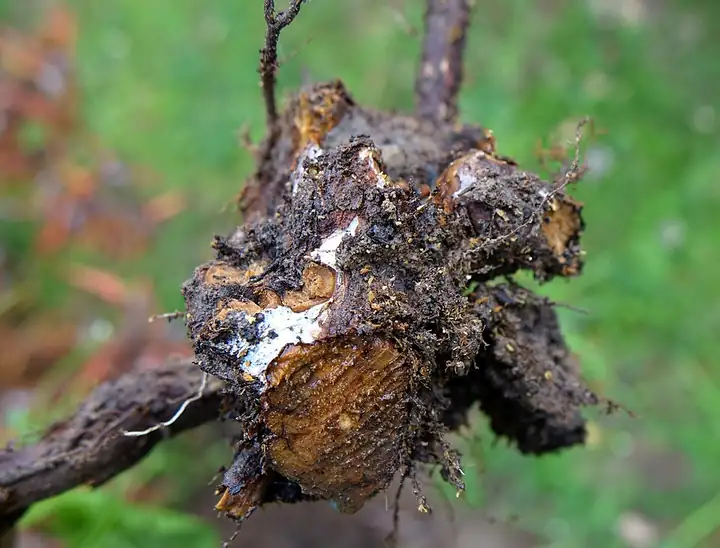
Root and crown rot
Soilborne water molds and fungi (Phytophthora, Pythium, Rhizoctonia and Fusarium species)
| Type | Fungus |
|---|---|
| Cause | Soilborne water molds and fungi (Phytophthora, Pythium, Rhizoctonia and Fusarium species) |
| When | Any time soil stays waterlogged, often after heavy rain or overwatering. |
About
Root and crown rots are caused by several soil organisms that attack roots and the base of the stem, nearly always where soil stays too wet. Once roots are rotted plants rarely recover, so drainage and careful watering are the real fix.
Also called root rot, root rots, root rot in wet soil, Phytophthora root rot, Fusarium crown and root rot, stem and root rots
How to recognize it
Symptoms
Plants look drought-stressed even in moist soil: leaves turn dull, yellow or reddish and wilt, and plants stunt or die. Roots are dark, soft and rotten and slough off easily, and the crown or lower stem may show dark, water-soaked or reddish-brown decay.
Often confused with
Drought also makes plants wilt, so check the roots: rotted roots are dark and soft and break off easily (UC IPM).
Worse when
Soggy, poorly drained soil, overwatering and deep planting; UC IPM says Phytophthora can infect after as little as 4 to 8 hours of saturated soil.
How it spreads
Resting spores survive for years in moist soil and move with water, soil and infected plants.
When
Any time soil stays waterlogged, often after heavy rain or overwatering.
What to do, gentlest first
Prevention works best; most sprays only protect healthy leaves and can't cure infected ones. Always read and follow the product label.
Improve drainage Prevent
Plant in well-drained soil or raised beds, and never let water stand around plants.
Water wisely and plant at the right depth Prevent
Water only as needed, and do not bury the crown or cover it with soil or mulch.
Start clean Prevent
Buy healthy, certified plants, use clean potting mix, and choose resistant varieties where available.
Remove dead plants and let crowns dry By hand
Pull dead plants with their roots, and for less severe cases pull soil back from the crown so it can dry.
Water-mold fungicides help only a little Conventional spray
Products such as phosphorous acid or fosetyl-aluminum exist for Phytophthora, but UC IPM warns not to rely on them alone; they will not fix wet soil.
Follow the label, including which crops it may be used on and how many days to wait before harvest.
Plants it affects
African violet, Agave (century plant), Ageratum (floss flower), Almond, Aloe vera, Amaranth (greens), Amaryllis, Anemone (windflower), Anise, Anise hyssop, Anthurium (flamingo flower), Arborvitae, Areca palm, Artichoke, Asparagus, Asparagus fern, Avocado, Azalea, Bachelor's button (cornflower), Banana (dwarf), Basil, Bay laurel, Beet, Bird of paradise, Black walnut, Blanket flower (gaillardia), Boston fern, Bougainvillea, Boxwood, Bromeliads, Calamondin, Calibrachoa (million bells), Camellia, Canna, Cardoon, Carrot, Cast iron plant, Catmint, Celery, Celosia, Cherry (sweet and tart), Chestnut, Chickpea, Chinese evergreen, Christmas cactus, Chrysanthemum (garden mum), Clivia (bush lily), Coleus, Coral bells (heuchera), Coreopsis (tickseed), Crocus, Croton, Crown of thorns, Cyclamen (florist's), Cymbidium orchid, Dahlia, Dendrobium orchid, Dewberry, Dianthus (pinks, sweet William, carnation), Dieffenbachia (dumb cane), Dracaena (corn plant, dragon tree), Dragon fruit (pitaya), Dusty miller, Eastern hemlock, Edging lobelia, Eggplant, Elephant ear, English ivy (houseplant), Fava bean, Fennel, Fiddle-leaf fig, Finger lime, Fir, Flowering cherry, Flowering dogwood, Forsythia, Garden phlox (tall phlox), Gardenia (cape jasmine), Gaura (whirling butterflies), Geranium (annual, Pelargonium), Gerbera daisy, Ginger, Gladiolus, Gomphrena (globe amaranth), Hardy kiwi (kiwiberry), Hazelnut (filbert), Heartleaf philodendron, Hens and chicks, Holly, Horseradish, Hoya (wax plant), Inch plant (wandering dude), Jade plant, Japanese barberry, Japanese pieris, Jicama, Kalanchoe, Kerria (Japanese kerria), Kumquat, Lamb's ear, Lantana (garden), Larkspur (annual larkspur), Lavatera (annual mallow), Lavender (English), Lemongrass, Lentil, Lime (key and Persian), Lingonberry, Liriope (lilyturf, monkey grass), Loropetalum, Lucky bamboo, Lungwort (Pulmonaria), Maiden grass (Miscanthus), Makrut lime, Mamey sapote, Mandarin (satsuma, clementine, tangerine), Marigold, Maypop (purple passionflower), Mexican mint marigold (Texas tarragon), Meyer lemon, Milkweed, Money tree, Monstera (Swiss cheese plant), Morning glory, Moth orchid, Mulberry (red and black), Natal plum (carissa), Nerve plant (fittonia), New Jersey tea, Nopal and prickly pear (Opuntia), Okra, Olive, Orange and blood orange, Pachysandra (Japanese spurge), Parlor palm, Passion fruit, Peace lily, Peas, Penstemon (beardtongue), Peperomia, Pepper (sweet and chili), Petunia, Pilea (Chinese money plant), Pineapple, Poinsettia, Polka dot plant, Ponytail palm, Poppy (Oriental, Iceland, corn and breadseed poppies), Portulaca (moss rose), Pothos, Prayer plants (calathea, maranta), Primrose, Radicchio, Ranunculus, Raspberry, Red hot poker (torch lily), Red maple, Red twig dogwood, Rhododendron, Rhubarb, Rubber plant, Russian sage, Saffron crocus, Salvia (ornamental sage), Santolina (lavender cotton), Sassafras, Scabiosa (pincushion flower), Sea lavender, Sedges (Carex), Sedum (stonecrop), Shasta daisy, Snake plant, Snapdragon, Spider plant, Spirea, Starfruit (carambola), Statice (annual statice), Stevia, Stock, Strawflower, String of hearts, String of pearls, Succulents (echeveria, haworthia, sedum), Surinam cherry, Swedish ivy, Sweet marjoram, Switchgrass, Tarragon (French), Tomatillo, Tomato, Torenia (wishbone flower), Tuberose, Turmeric, Umbrella plant (schefflera), Verbena (garden verbena), Veronica (speedwell), White sapote, Wisteria, Yarrow, Yew, Yucca cane, ZZ plant
Sources
Photo: Photo: Jerzy Opioła, CC BY-SA 4.0, via Wikimedia Commons (CC BY-SA 4.0). Photo resized for the web.

Planting dates and advice are general guidance; check with your local Cooperative Extension office for your area.