
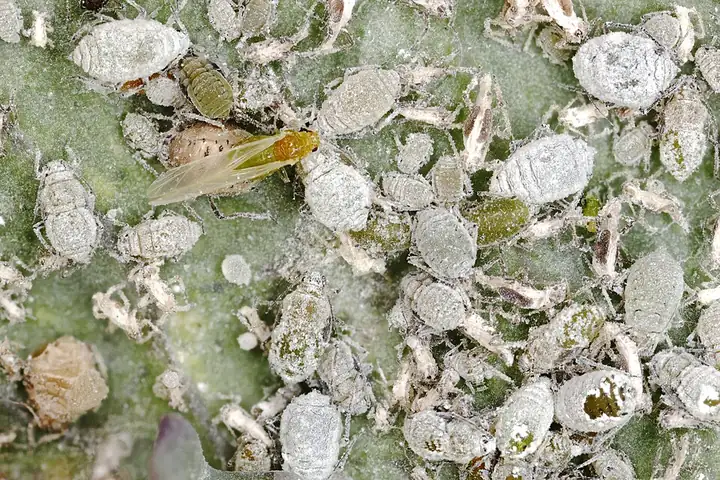
Aphids
Many species (family Aphididae), such as the green peach aphid (Myzus persicae) and the cabbage aphid
| Type | Insect |
|---|---|
| Pressure by region | Moderate: all regions |
About
Aphids are soft, pear-shaped insects about an eighth of an inch long, in green, black, pink or gray, with two small tubes (cornicles) at the rear. In warm weather females give birth to live young without mating, so a few aphids can become a crowd within a week.
Spotting it
Damage
New growth curls, puckers and yellows, and leaves get sticky with honeydew that turns black with sooty mold. Many aphids also spread plant viruses, which often does more harm than the feeding.
How to find it early
Check the undersides of the newest leaves and the growing tips. White cast skins on the leaves, sticky honeydew, or a trail of ants climbing a stem are early signs.
When
Spring through fall; UC IPM says damage peaks in late spring when it is warm but not hot (65-80°F).
Life cycle
Most species spend winter as eggs on plants; in spring the eggs hatch into females that bear live young without mating, and in warm weather many can go from newborn to reproducing adult in seven to eight days, so generations stack up all season (cabbage aphids can have up to 15). In fall males appear and mated females lay the overwintering eggs.
What to do, gentlest first
Start at the top. Sprays are a last step; always read and follow the product label.
Go easy on nitrogen Prevent
Heavy nitrogen fertilizer speeds aphid breeding. Use slow-release or organic fertilizer in small doses through the season.
Reflective mulch Prevent
Silver reflective mulch under squash, melons and similar crops repels incoming aphids and cuts the spread of aphid-borne viruses.
Hard spray of water By hand
Knock aphids off sturdy plants with a strong jet of water early in the day so leaves dry quickly. Most dislodged aphids cannot climb back.
Protect natural enemies and stop the ants Natural enemies
Lady beetles, lacewings, hoverfly larvae and tiny parasitic wasps usually bring aphids down within a week or two once swollen, tan 'mummy' aphids appear. Ants guard aphids from these predators, so block ants with sticky bands or ant baits.
Store-bought ladybugs mostly fly away within days; the ones that show up on their own do more of the work.
Insecticidal soap or horticultural oil Organic spray
These smother aphids, so wet the undersides of leaves thoroughly. Repeat as needed, since they leave no lasting residue.
Do not spray soaps or oils on water-stressed plants or when it is over 90°F. They work only on contact, and oil sprays can stun or kill bees they hit, so spray when bees are not on the plants. Read and follow the label.
Avoid broad-spectrum and systemic insecticides Conventional spray
UC IPM discourages malathion and permethrin sprays on food crops because they kill the lady beetles, lacewings and parasitic wasps that give long-term control. Soap or oil is the better choice.
Do not use systemic neonicotinoids such as imidacloprid on food crops that are flowering or about to flower; they can harm bees and other pollinators (UC IPM, UMN). If you use any insecticide, read and follow the label, including the days to wait before harvest.
Garden friends that go after it
Aphid midge, Assassin bugs (incl. the wheel bug), Big-eyed bugs, Braconid wasps (incl. hornworm cocoon wasps and aphid mummy wasps), Brown lacewings, Crab spiders (flower spiders), Damsel bugs, Green lacewings, Ground beetles, Harvestmen (daddy longlegs), Jumping spiders, Lady beetles (ladybugs), Minute pirate bugs, Rove beetles, Snakeflies, Soldier beetles (leatherwings), Syrphid flies (hover flies, flower flies)
Protect these helpers: skip broad sprays when they're around.
Plants it goes after
African violet, Ageratum (floss flower), Aloe vera, Amaranth (greens), American plum (wild plum), Angelonia (summer snapdragon), Anise, Anthurium (flamingo flower), Apothecary rose, Apple (backyard tree), Apricot, Aronia (black chokeberry), Arrowhead vine (syngonium), Artichoke, Arugula, Asparagus, Asparagus fern, Aster, Azalea, Baby's breath, Bachelor's button (cornflower), Banana (dwarf), Barbados cherry (acerola), Bird of paradise, Black raspberry (blackcap), Black walnut, Black-eyed Susan, Blackberry, Blanket flower (gaillardia), Bleeding heart, Bok choy, Bougainvillea, Bradford pear (Callery pear), Broccoli, Broccoli raab (rapini), Brussels sprouts, Cabbage, Calamondin, Calendula (pot marigold), Calibrachoa (million bells), California poppy, Camellia, Canna, Cantaloupe (muskmelon), Caraway, Cardoon, Carrot, Celeriac, Celery, Celosia, Chamomile (German), Chaya (tree spinach), Chayote, Chickpea, Chilacayote, Chinese evergreen, Chokecherry, Christmas cactus, Chrysanthemum (garden mum), Cilantro (coriander), Clematis, Cleome (spider flower), Coleus, Colorado blue spruce, Columbine, Cosmos, Crape myrtle, Cucamelon, Cucumber, Currant, Cyclamen (florist's), Cymbidium orchid, Daffodil, Dahlia, Daylily, Delphinium, Deutzia, Dieffenbachia (dumb cane), Dill, Dry beans (pinto, black, kidney, navy), Eastern white pine, Edamame, Eggplant, Elderberry (American), Elephant ear, English ivy (houseplant), Epazote, Fava bean, Fennel, Fiddle-leaf fig, Fig, Finger lime, Fir, Flowering cherry, Flowering crabapple, Flowering tobacco (nicotiana), Forsythia, Foxglove, Fuchsia, Gardenia (cape jasmine), Gaura (whirling butterflies), Geranium (annual, Pelargonium), Gerbera daisy, Gladiolus, Glossy abelia, Goji (wolfberry), Goldenrod, Gooseberry, Green beans (snap beans), Hackberry, Hardy hibiscus (rose mallow), Hazelnut (filbert), Heartleaf philodendron, Hellebore (Lenten rose), Holly, Hops, Hydrangea, Hydrangea tree (panicle hydrangea), Impatiens, Inch plant (wandering dude), Iris, Jaboticaba, Jade plant, Japanese barberry, Japanese maple, Jicama, Jostaberry, Juniper, Kalanchoe, Kale, Kumquat, Larkspur (annual larkspur), Lemon, Lemon verbena, Lentil, Lettuce, Lily (Lilium), Lime (key and Persian), Linden, Loquat, Loropetalum, Luffa (loofah gourd), Lupine (and Texas bluebonnet), Mâche (corn salad), Makrut lime, Mandarin (satsuma, clementine, tangerine), Mandevilla, Mayhaw, Medlar, Mexican mint marigold (Texas tarragon), Mexican sunflower (tithonia), Meyer lemon, Milkweed, Mock orange, Money tree, Monstera (Swiss cheese plant), Morning glory, Mustard greens, Nanking cherry, Napa cabbage, Nasturtium, Oaks (white, red and pin oak), Obedient plant, Okra, Oleander, Orange and blood orange, Ornamental kale and cabbage, Ornamental sweet potato vine, Pansy and viola, Passion fruit, Peach, Peanut, Pear, Peas, Pecan, Pentas (Egyptian star flower), Pepper (sweet and chili), Petunia, Plum, Polka dot plant, Poppy (Oriental, Iceland, corn and breadseed poppies), Portulaca (moss rose), Potato, Prayer plants (calathea, maranta), Primrose, Purple coneflower (echinacea), Purple heart, Radicchio, Ranunculus, Red maple, River birch, Rose (garden and landscape roses), Rose of Sharon (shrub althea), Rutabaga, Salvia (ornamental sage), Scabiosa (pincushion flower), Sedges (Carex), Sedum (stonecrop), Serviceberry (juneberry, saskatoon), Sesame, Shallot, Shasta daisy, Snapdragon, Sorghum (sweet and grain), Southern peas, Spinach, Spirea, Statice (annual statice), Stevia, Stock, Strawberry, Strawflower, String of hearts, String of pearls, Sugar maple, Sumac, Sunflower, Swedish ivy, Sweet corn, Sweet pea, Swiss chard, Tamarind, Tomatillo, Tomato, Tropical hibiscus, Tropical pitcher plant (nepenthes), Trumpet honeysuckle (coral honeysuckle), Tuberose, Tulip, Tulip tree, Umbrella plant (schefflera), Venus flytrap, Verbena (garden verbena), Viburnum, Watercress, Watermelon, White sapote, Wild geranium (spotted cranesbill), Winter squash and pumpkin, Witch hazel, Yacon, Yucca cane, Zucchini and summer squash, ZZ plant
Pressure by region
Aphids turn up in every zone, including Alaska gardens and greenhouses and Hawaii home gardens. UC IPM notes that summer heat and winter cold hold them back, so in hot-summer areas expect the worst of it in spring and fall.
| Northeast | Moderate |
|---|---|
| Southeast | Moderate |
| South Central | Moderate |
| Midwest | Moderate |
| Great Plains | Moderate |
| Mountain West | Moderate |
| Southwest | Moderate |
| Pacific Northwest | Moderate |
| California | Moderate |
| Alaska | Moderate |
| Hawaii | Moderate |
Ratings come from extension sources where available; some are estimates, as noted above.
Sources
- extension.umn.edu
- ipm.ucanr.edu
- ipm.ucanr.edu
- alaskamastergardener.community.uaf.edu
- www3.ctahr.hawaii.edu
- s3.wp.wsu.edu
Photo: Photo: Sanjay Acharya, CC BY-SA 4.0, via Wikimedia Commons (CC BY-SA 4.0). Photo resized for the web.

Planting dates and advice are general guidance; check with your local Cooperative Extension office for your area.